


Student travel has rebounded—and diversified.
Globally, nearly 6.9 million tertiary students studied outside their home country in 2023, about triple the number two decades ago.
In the U.S., colleges hosted an all-time high 1,126,690 international students in 2023/24, while 280,716 U.S. students went abroad for academic credit in 2022/23.
Leaders say the momentum is historic.
“As we celebrate 75 years of Open Doors, we are thrilled to report a record high of international students in the United States.”
— Allan E. Goodman, CEO, Institute of International Education (IIE)
Key stats: Student Travel
- In 2024, 848,000 students traveled domestically (student group travel) — down ~2% from 2023 but still twice the 2019 levels.
- Student travel is a major force: it accounts for roughly 23% of global international arrivals.
- Many student travel programs are hybrid: 64% of operators run both domestic and international trips.
- The student travel market is huge — ~$320 billion in 2023, with forecasts pointing to ~$550 billion by 2032.
- Among Gen Z travelers, 78% believe travel boosts their employability and 87% would engage in career-related volunteering or work while traveling.
- Environmental concern is rising: 13% of student/youth travelers avoid flying for its carbon impact; 21% know someone who refuses to fly.
- In the U.S., 1.1 million international students were enrolled in 2023-24, contributing over $50 billion to the economy.
- The U.S. alone hosts ~15% of global international students, making it a key destination in global student mobility.
What are the key student travel stats right now?
- Internationally mobile students worldwide: ~6.9 million (2023), up from ~2.1 million in 2000.
- U.S. hosts international students: 1,126,690 (2023/24, +7%)—a record.
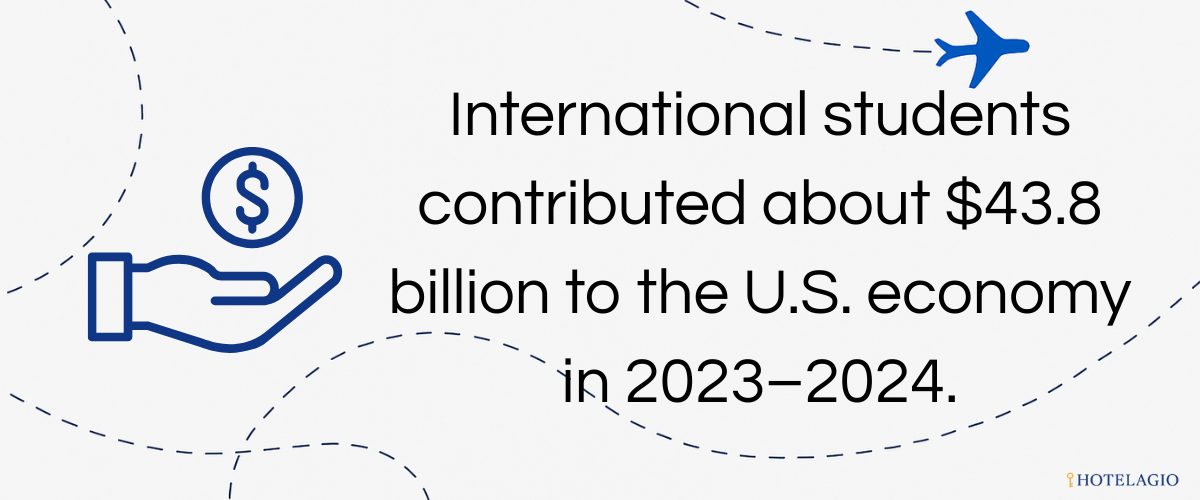
- Economic impact (U.S.): International students contributed $43.8B and supported 378,175 jobs in 2023/24.
- U.S. students abroad: 280,716 (2022/23, +49% YoY) for academic credit; 400k+ engaged in global learning overall.
- Youth & student trips (global behavior): Avg. spend just under €3,000 on the last main international trip; 69% of total trip cost is spent in-destination.
- Europe’s Erasmus+: ~1.3 million learning-mobility opportunities in 2023; 23% used low-emission transport.
How big is “student mobility” worldwide?
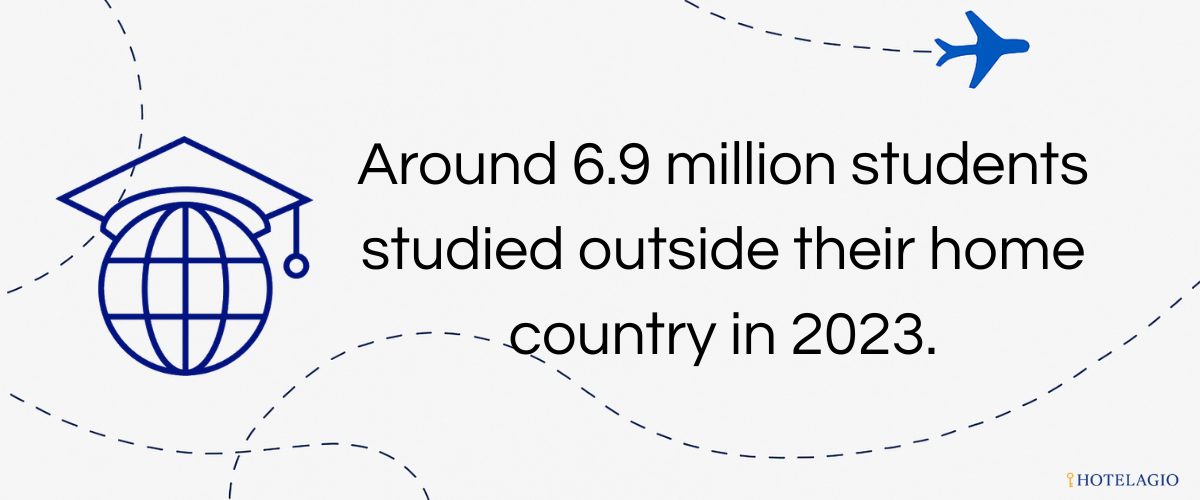
UNESCO’s latest releases show a powerful long-term trend: internationally mobile higher-ed students nearly tripled to ~6.9 million in 2023, even as total global enrolment reached ~264 million. Europe and North America host more than half of all mobile students.
Why it matters: only a small share of the world’s 264M students can study abroad—so demand for mobility (and for transnational education options) remains strong.
And there’s room to grow.
“With nearly 4,000 education institutions, the U.S. has the most capacity to host more international students.”
— Mirka Martel, Head of Research, IIE
How is student travel showing up in the U.S. numbers?
- Incoming: U.S. higher ed hosted 1,126,690 international students in 2023/24 (record, +7% YoY). Graduate enrolments and OPT hit all-time highs.
- Impact: International students generated $43.8B in economic value and 378k+ jobs nationwide in 2023/24.
- Outgoing: 280,716 U.S. students studied abroad for credit in 2022/23; top destinations were Italy, the U.K., Spain, and France (45% combined). Women accounted for 67% of study-abroad participants.
“The experience of studying in the United States not only shapes the lives of individuals, but the future of our interconnected world.”
— Scott Weinhold, Senior Bureau Official, U.S. Department of State (ECA)
U.S. Snapshot (latest official)
| Metric | Latest figure |
|---|---|
| International students hosted (2023/24) | 1,126,690 |
| Economic impact (2023/24) | $43.8B; 378,175 jobs |
| U.S. students abroad for credit (2022/23) | 280,716 |
| Most common U.S. study-abroad majors | Business (20%), Social sciences (18%) |
Sources: IIE Open Doors; NAFSA.
What do youth & student trips look like (spend, length, style)?
The New Horizons 5 global study (WYSE Travel Confederation) shows how under-30 student/youth travelers behave:
- Average spend: Just under €3,000 on the last main international trip.
- Where money goes: ~69% of total trip cost is spent in-destination (local stays, food, activities, transport).
- Trip length: Average duration shortened to 41 days (from 52 in 2017).
- Traveling solo: Less solo travel than in 2017.
Context note: WYSE & UN Tourism estimate youth/student travel ≈ 23% of all international arrivals (long-standing benchmark; newer shares vary by region).
Meeting Gen Z where they are matters.
“Catering to Generation Z on environment, health, safety and digital ease is key; visas, sustainability and affordability will be critical issues.”
— David Chapman, Director General, WYSE Travel Confederation
What’s happening in Europe (Erasmus+ and beyond)?
Erasmus+ remains a global bellwether for educational mobility:
- Scale: ~1.3 million people participated in learning mobility in 2023 (students, staff, youth).
- Greener travel: 23% used low-emission transport (train, bus, car-pool) for the main leg.
- Hosts: In 2023, the EU hosted ~1.76 million tertiary students from abroad; Germany had the largest share (423,200).
Where do U.S. students study abroad most—and who goes?
Per IIE Open Doors 2022/23, Italy, the U.K., Spain, and France are top picks; seven destinations reached all-time highs (e.g., Denmark, Greece, Italy, Japan, Singapore, South Korea, Switzerland).
The student profile remains stable: 67% women, 34% students of color; Business and Social sciences lead by field.
Leading Destinations (U.S. study abroad, 2022/23)
| Rank | Destination | Note |
|---|---|---|
| 1 | Italy | Long-time #1 |
| 2 | United Kingdom | |
| 3 | Spain | |
| 4 | France | These four = 45% of all U.S. study-abroad students |
| … | Japan, South Korea, Denmark, Greece, Switzerland, Singapore | Several reached record highs |
Source: IIE Open Doors (2024 release).
What trends will shape student travel next?
- Mobility demand stays high: The world may pass 9 million mobile students by 2030 if current trends hold.
- Destination mix shifts: Europe/North America still host most mobile students, but diversification is visible year-to-year.
- Spending local matters: With ~69% of youth/student trip costs spent in-destination, communities see tangible benefits.
- Greener travel nudges: Erasmus+ shows measurable low-emission uptake—a signal for rail-first and slow-travel products.
Student Travel FAQ
How many students study outside their home country?
Roughly 6.9 million worldwide in 2023, about 3× the level in 2000.
What’s the latest U.S. picture?
1.13 million international students enrolled in 2023/24; $43.8B economic contribution. 280,716 U.S. students went abroad in 2022/23.
How much do student/youth travelers spend?
About €3,000 on their last big international trip, on average—69% of spending happens in-destination.
Is Europe still the top magnet for U.S. study abroad?
Yes—Italy, the U.K., Spain, France led in 2022/23; several non-European destinations hit record highs, too.
Sources
- UNESCO / The PIE News — Internationally mobile students triple to ~6.9M (2023)
- IIE Open Doors — International Students in the U.S. 2023/24
- NAFSA — International Student Economic Value: $43.8B (2023/24)
- IIE Open Doors — U.S. Study Abroad 2022/23 (destinations, profile)
- WYSE Travel Confederation — New Horizons 5 (avg. spend, 69% in-destination, 41-day trips)
- WYSE Travel Confederation — Youth/Student travel share ≈23% of global arrivals (context)
- European Commission — Erasmus+ supported ~1.3M opportunities in 2023; 23% low-emission transport
- Eurostat — Students from abroad in the EU (2023)

0 Comment