


Cultural travel is having a moment.
UNESCO has long estimated that cultural tourism generates roughly 40% of global tourism revenues, a share that helps explain why museums, heritage sites, festivals, and culinary routes are back at the center of trip planning.
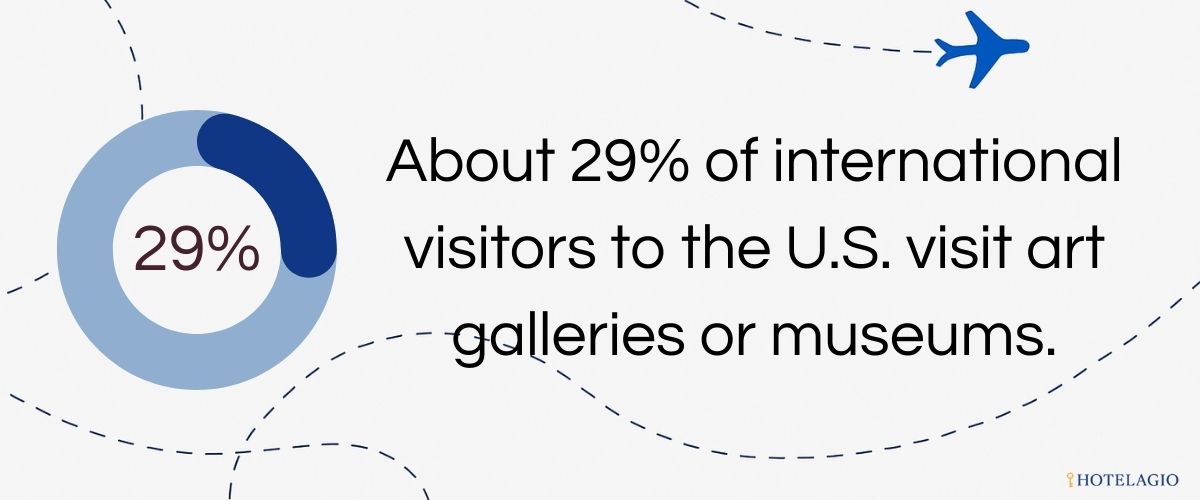
In the United States, culture is a decisive nudge: the National Travel & Tourism Office’s latest inbound survey shows about 29% of overseas visitors went to art galleries or museums in Q2 2024—placing cultural venues among the most common activities for international travelers.
Key stats: Cultural Tourism
- The cultural tourism market is valued at ~USD 7.96 billion in 2025, with projections to more than double by 2032.
- Growth forecasts are strong — ~14.5% CAGR (2025–2032) in many analyses.
- In the U.S., cultural heritage tourism contributes about $123.6 billion in economic impact.
- Globally, cultural tourism is estimated to make up ~40% of all tourism activity.
- 30% of travelers say they chose a destination because of a cultural or heritage event or attraction.
- The market is forecast to rise by USD 8.41 billion between 2024 and 2029, with ~18.4% CAGR.
- 29%: Overseas visitors to the U.S. who visited art galleries/museums in Q2 2024 (SIAT, NTTO).
- 35.3 million: U.S. adults who say a specific arts/cultural/heritage event influenced their choice of destination (Americans for the Arts, 2025 factsheet citing national travel research).
- $604.4 billion (2024) → $778.1 billion (2030): Global heritage tourism market size (a core pillar of cultural tourism), per Grand View Research.
- 8.7 million visitors: 2024 attendance at the Louvre, confirming blockbuster museum demand post-pandemic.
- Up to 13 million visitors projected in 2025 at Notre-Dame de Paris after its late-2024 reopening, underlining heritage restoration’s pull.
How big is cultural tourism globally, and how fast is it growing?

The global travel recovery remains strong: UN Tourism tracked 690 million international tourists in the first half of 2025, putting volumes within striking distance of pre-pandemic peaks.
Within that rebound, cultural experiences—museums, historic districts, performing arts, and festivals—continue to capture a large slice of spend and jobs.
Methodologies differ by source, but two signals are consistent. First, UNESCO’s framing that cultural tourism accounts for about 40% of tourism revenues still anchors policy discussions.
Second, market analysts show rapid growth in heritage tourism—a major component of cultural travel—reaching $604.4B in 2024 with momentum into the next decade.
Consider the 40% share a structural indicator, and the heritage market values a near-term growth proxy.
What do visitors actually do on cultural trips?
In the U.S., cultural activities rank near the top for inbound travelers. In Q2 2024, international air visitors most commonly reported Shopping (80%), Sightseeing (75%), National Parks/Monuments (35%), and Art Galleries/Museums (29%). These patterns mirror how many “culture trips” blend museums with neighborhoods, parks, architecture, and food.
Outside the U.S., a similar mix shows up in Europe’s city breaks and festival circuits, while culinary heritage routes (from wine to whiskey) continue to expand. In Kentucky, for example, the Bourbon Trail drew 2.5 million visitors in 2023, illustrating how craft and heritage can define a destination.
Which destinations and sites illustrate the scale?
Museum attendance snapshots (latest public figures)
| Venue | 2024 attendance |
|---|---|
| Louvre, Paris | 8.7 million |
| Vatican Museums | 6.8 million |
| British Museum | 6.48 million |
| The Met, New York | 5.73 million |
Heritage sites also move the needle. Notre-Dame’s full reopening (Dec 2024) triggered a surge—1.8 million entries in July–August 2025 alone—on pace for ~13 million visitors by year-end. That kind of landmark recovery can reshape city itineraries and seasonal patterns.
“Visiting the Louvre is a physical ordeal; accessing the artworks takes time and is not always easy.”
— Laurence des Cars, President-Director, Musée du Louvre.
How large is the economic impact of culture on travel?
Direct “tourism-only” tallies are fragmented, but macro data show scale. In the U.S., arts and cultural industries (not solely tourism, but deeply intertwined with it) added $1.2 trillion to GDP in 2023, growing twice as fast as the overall economy that year, per NEA/BEA. Those industries drive venues, programming, and jobs that cultural travelers consume.
On the demand side, Americans for the Arts reports 35.3 million adults say a specific arts/cultural/heritage event influenced where they traveled—evidence that culture is a decision-maker, not just an add-on.
What trends are shaping cultural tourism in 2025?
Managing overtourism and experience quality. The Louvre has capped daily entries around 30,000 and announced a multi-year overhaul aimed at flow, amenities, and visitor experience—an approach increasingly common at top cultural sites.
Restoration as a driver. High-profile reopenings (e.g., Notre-Dame) can reset a city’s cultural calendar and lift annual visitation beyond prior benchmarks.
Festivals and cultural programming. UNESCO’s 2025 note on festivals documents fresh local jobs and spending, underscoring how programming can spread benefits beyond core museum districts.
Heritage routes and regional brands. Culinary and craft trails (bourbon, wine, cheese, design) keep deepening stays and spending—often outside the biggest gateway cities.
“Arts travelers are ideal tourists, staying longer and spending more to seek out authentic culture experiences.”
— Americans for the Arts
At-a-glance cultural tourism datapoints
| Indicator | Latest datapoint | Why it matters |
|---|---|---|
| Cultural tourism share of global tourism revenues | ~40% (UNESCO, 2021) | Long-standing structural share used in policy and planning. |
| U.S. inbound: museum/gallery visitation | 29% (Q2 2024) | Cultural venues remain core activities for overseas visitors. |
| Heritage tourism market (global) | $604.4B (2024) → $778.1B (2030) | Sub-sector growth proxy for cultural travel demand. |
| Louvre museum attendance | 8.7M (2024) | Flagship indicator of global museum demand. |
| Notre-Dame post-reopening | Up to 13M (2025 projection) | Restoration can drive surges in cultural visitation. |
FAQ: Cultural Tourism
How big is cultural tourism as a share of travel?
UNESCO’s policy guidance has long cited cultural tourism at around 40% of global tourism revenues. While methodologies vary, the share remains a useful benchmark in 2025.
Do overseas visitors to the U.S. prioritize cultural activities?
Yes. In Q2 2024, 29% visited art galleries/museums (and 35% visited national parks/monuments), per NTTO’s inbound survey.
Which museum is the world’s most visited?
The Louvre topped 2024 with 8.7 million visitors (museum press). Vatican Museums reported 6.8 million (The Art Newspaper).
Is cultural tourism growing?
Yes. UN Tourism reports strong overall international travel in 2025. Within that, heritage tourism—a core cultural segment—shows robust market growth through 2030.
What’s a recent example of culture reshaping a destination?
Notre-Dame’s December 2024 reopening spurred record attendance in 2025, with projections up to 13 million visitors for the year.
Sources
- UN Tourism — World Tourism Barometer (H1 2025)
- UNESCO — Cutting Edge: Bringing Cultural Tourism Back in the Game (2021)
- U.S. Department of Commerce (NTTO) — Survey of International Air Travelers: Q2 2024 inbound results
- Americans for the Arts — Arts + Tourism factsheet (updated, 2025 site)
- Grand View Research — Heritage Tourism Market Size & Trends (to 2030)
- Musée du Louvre — Press release: 8.7 million visitors in 2024
- The Art Newspaper — The world’s most-visited museums 2024 (ranking)
- Le Monde — Notre-Dame breaks attendance records (2025)
- NEA — Arts & Cultural Industries Grew at Twice the Rate of the U.S. Economy (2023 data)
- U.S. BEA — Arts & Cultural Production Satellite Account: U.S. and States, 2023
- AP News — Kentucky tourism 2023: Bourbon Trail visitors and economic impact
- UNESCO — Report: Arts & Culture Festivals Drive Development (2025)

0 Comment