


Beach travel remains one of the world’s favorite ways to vacation.
Globally, coastal destinations are rebuilding on the back of a broader tourism recovery, with international arrivals up about five percent in the first half of 2025 compared with 2024.
In Europe’s coastal areas, foreign visitors now account for a majority of nights, while sustainability signals like Blue Flag certifications continue to grow.
In the United States, ocean-based tourism and recreation are a major employer and a large slice of the marine economy.
Key Stats: Beach Tourism
- The global beach tourism market was worth about USD 281 billion in 2024, with projections reaching USD 466.7 billion by 2033 if current growth continues.
- Another forecast estimates the market will grow to USD 255.6 billion in 2025, from USD 240.0 billion in 2024, at ~6.5% growth.
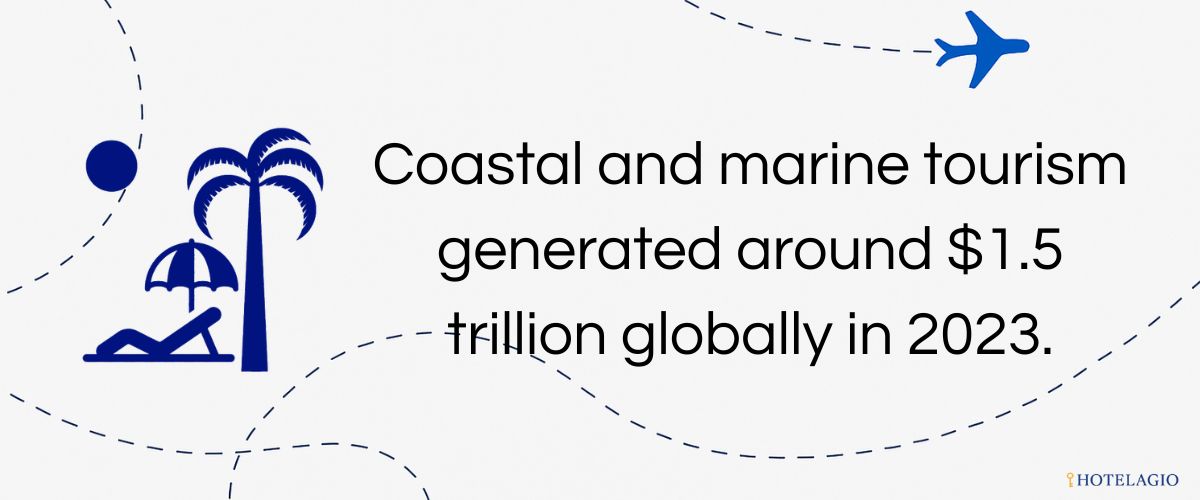
- In 2023, coastal & marine tourism alone generated USD 1.5 trillion globally and supported 52 million jobs.
- That sector accounts for roughly half of all global tourist spending, with USD 820 billion in direct tax revenue.
- In the U.S., ocean-based tourism underpins 2.5 million jobs, contributes USD 143 billion in GDP, and pays USD 66 billion in wages.
- Pre-pandemic (2019), U.S. beaches saw around 3.3 billion tourist visits.
- In 2023, Virginia Beach recorded USD 3.8 billion in tourism impact.
- In the first half of 2024, 5.19 million visitors came to The Palm Beaches, spending USD 4.05 billion.
- For the full year 2024, The Palm Beaches broke records with 9.9 million visitors — up 4.6% from 2023.
Beach travel is not just popular; it’s a major economic engine in its own right.
“Beach tourists annually generate $520 billion in economic output, $240 billion in direct spending, and $36 billion in taxes to federal, state, and local governments.”
— J.R. Houston, Ph.D., coastal economist, Shore & Beach (2024)
What are the key beach tourism numbers right now?
- Global beach tourism market size is commonly estimated in the $250–$281 billion range for 2024–2025, with forecasts to $365–$467 billion by 2032–2033. Methodologies differ, but all point to steady mid-single-digit growth.
- Blue Flag eco-labels: official 2024/2025 counts list Spain 749, Greece 657, Türkiye 625, Italy 571, Portugal 444, France 492 total flags across beaches, marinas and tourism boats.
- In the European Union’s coastal areas, foreign visitors represented 57% of tourism in 2023, with Cyprus at 94%, Croatia and Malta 93%, Greece 86%.
- In the United States, ocean-based tourism and recreation contribute roughly $143 billion in GDP, pay about $65.6 billion in annual wages, and employ about 2.5 million people, based on NOAA’s latest compiled series.
- A 2024 peer-reviewed analysis estimates 3.4 billion annual visits to U.S. beaches, with beach tourists spending roughly $240 billion in 2022.
How big is the global beach tourism market, and is it growing?
There’s no single official tally for “beach tourism,” so researchers triangulate using travel surveys, spend patterns, and destination reporting. Two widely cited market studies frame the scale:
Global Beach Tourism Market: Comparable Estimates
| Source | Base Year | Market Size | Forecast Horizon | Forecast Size | CAGR |
|---|---|---|---|---|---|
| Coherent Market Insights | 2025 | $250.7B | to 2032 | $365.0B | 5.5% |
| Market Data Forecast | 2024 | $281.0B | to 2033 | $466.7B | 5.8% |
Both indicate a resilient, growing category, supported by recovering long-haul travel in 2024–2025 and durable demand for sun-and-sea trips.
Where are the “cleanest” and best-managed beaches?
Environmental standards are one way to compare quality. The Blue Flag program audits water quality, safety, access, and environmental education. Its latest public country totals show Europe dominating the league tables, with Spain at the top.
Blue Flag Leaders, 2024/2025 Season
| Country | Total Blue Flags | Breakdown (Beaches/Marinas/Boats) |
|---|---|---|
| Spain | 749 | 642 / 101 / 6 |
| Greece | 657 | 623 / 17 / 17 |
| Türkiye | 625 | 577 / 30 / 18 |
| Italy | 571 | 487 / 84 / 0 |
| Portugal | 444 | 404 / 18 / 22 |
| France | 492 | 388 / 104 / 0 |
Source: Blue Flag official site map for 2024/2025 and upcoming 2025 Northern Hemisphere season. Counts are totals of beaches, marinas, and boats.
Quality labels help travelers choose beaches that invest in safety, access, and water standards.
“The Blue Flag award highlights the best of Canada’s waterfronts.”
— Gregary Ford, Vice President & Lake Ontario Waterkeeper, Swim Drink Fish (Blue Flag Canada)
How important is beach tourism in the U.S. economy?
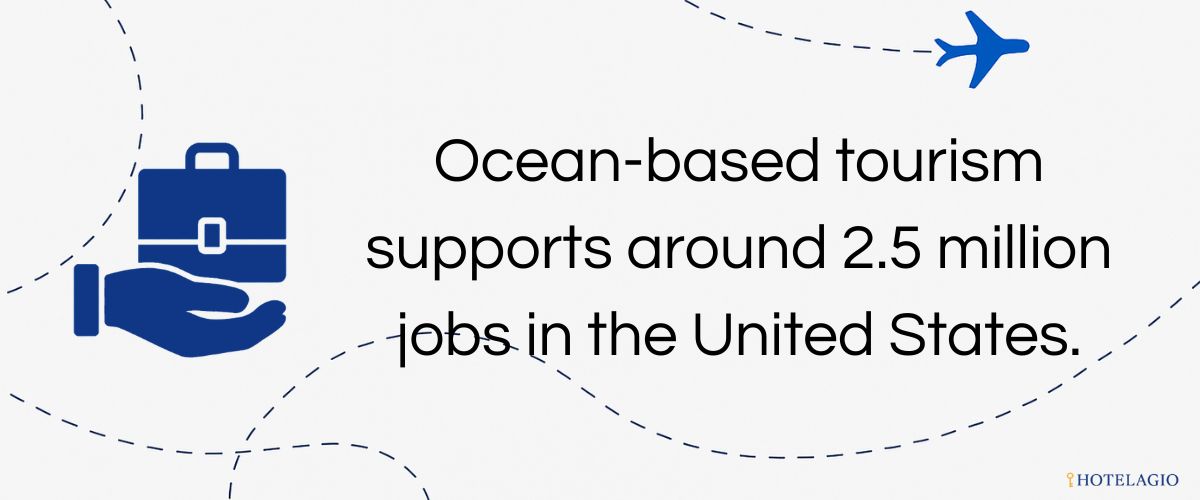
Ocean-based tourism and recreation are among the largest employers in America’s marine economy.
NOAA’s latest compiled indicators show roughly $143 billion in GDP, $65.6 billion in wages, and approximately 2.5 million jobs in this sector.
A broader Marine Economy report for 2021 shows 3.2 million marine-economy jobs overall and highlights tourism and recreation as the sector that accounts for about 65% of marine-economy employment.
A separate, beach-specific perspective estimates 3.4 billion annual beach visits nationwide and $240 billion in beach tourist spending in 2022, illustrating how beach trips anchor U.S. leisure demand.
U.S. Ocean-Based Tourism and Recreation (latest NOAA series)
| Indicator | United States |
|---|---|
| GDP contribution | ~$143B |
| Annual wages | ~$65.6B |
| Employment | ~2.5M jobs |
Source: NOAA Office for Coastal Management, Tourism and Recreation fast facts.
Public investment underpins the visitor experience and long-term value of beach destinations.
“Continued public support for shore restoration is crucial to building coastal resilience to storms and rising seas.”
— Tony Pratt, President, American Shore & Beach Preservation Association
How international is coastal tourism in Europe?
Coastal destinations in the EU rely heavily on international demand.
In 2023, 57% of coastal-area tourism was from foreign residents, with some countries far above average: Cyprus 94%, Croatia and Malta 93%, Greece 86%. That mix matters for seasonality, air connectivity, and resilience to exchange-rate swings.
What about sustainability and beach quality risks?
Travelers vote with their feet when beaches aren’t clean.
“This study shows that beachgoers are worried about marine debris and will seek out cleaner beaches for recreation at a cost.”
— Nancy Wallace, Director, NOAA Marine Debris Program
Tourism depends on clean shorelines.
NOAA’s research shows that marine debris directly reduces beach visitor days and local revenue; for example, a modeled doubling of debris in California’s Orange County could cost $414 million in tourism losses.
Certifications like Blue Flag help promote beach management standards around water quality and safety, while also signaling to travelers that a destination invests in stewardship.
Sustainability that moves the needle goes beyond a single property.
“It’s not just about spending on sustainability in the hotel, it’s about going outside of the hotel.”
— Neil Jacobs, CEO, Six Senses
At-a-glance beach tourism figures
| Topic | Latest datapoint |
|---|---|
| Global beach tourism market | $250–$281B current; $365–$467B by 2032–2033 |
| EU coastal areas foreign share | 57% in 2023; Cyprus 94%, Croatia/Malta 93%, Greece 86% |
| Blue Flag leaders | Spain 749; Greece 657; Türkiye 625; Italy 571; Portugal 444 |
| U.S. ocean-based tourism & recreation | $143B GDP, $65.6B wages, ~2.5M jobs |
| U.S. beach visits & spend | 3.4B annual visits; $240B spend in 2022 |
| Global travel backdrop | International arrivals +5% in H1 2025 vs 2024 |
FAQ: Beach Tourism
Is global beach tourism fully recovered?
International travel overall surpassed 2019 levels in early 2025, which supports coastal destinations. Exact “beach-only” totals vary by method, but demand is robust.
Which countries have the most certified clean and well-managed beaches?
By Blue Flag totals in 2024/2025: Spain, Greece, Türkiye, Italy, and Portugal lead, followed by France.
How big is beach tourism in the United States?
NOAA indicators show ocean-based tourism and recreation at roughly $143 billion in GDP with about 2.5 million jobs, and beach-specific research estimates 3.4 billion visits a year.
Are foreign visitors important to Europe’s coasts?
Yes. Foreign residents made up 57% of coastal tourism in 2023 on average, with several Mediterranean destinations far above that mark.
Does litter actually affect tourism revenue?
Yes. NOAA modeling finds that more marine debris reduces visitor days and can trim hundreds of millions of dollars from local beach economies.
Sources
- UN Tourism — World Tourism Barometer (H1 2025)
- European Commission — EU Blue Economy Report 2025: Coastal Tourism
- Blue Flag (FEE) — All Blue Flag awarded sites per country, season 2024/2025
- NOAA Office for Coastal Management — Tourism & Recreation Fast Facts (latest compiled series)
- NOAA/BEA — U.S. Marine Economy Report (2024; 2021 data highlights)
- Shore & Beach (JR Houston, 2024) — The Economic Value of America’s Beaches
- Market Data Forecast — Beach Tourism Market Size, Share & Growth
- Coherent Market Insights — Beach Tourism Market: 2025–2032 Forecast
- NOAA Marine Debris Program — Economic Impacts of Marine Debris on Tourism

0 Comment