


Backpacker travel is firmly back on the move — and the youth segment that contains most backpackers is now a major slice of global tourism.
In 2023, travelers under 30 accounted for about 23% of all international arrivals (roughly 296 million trips).
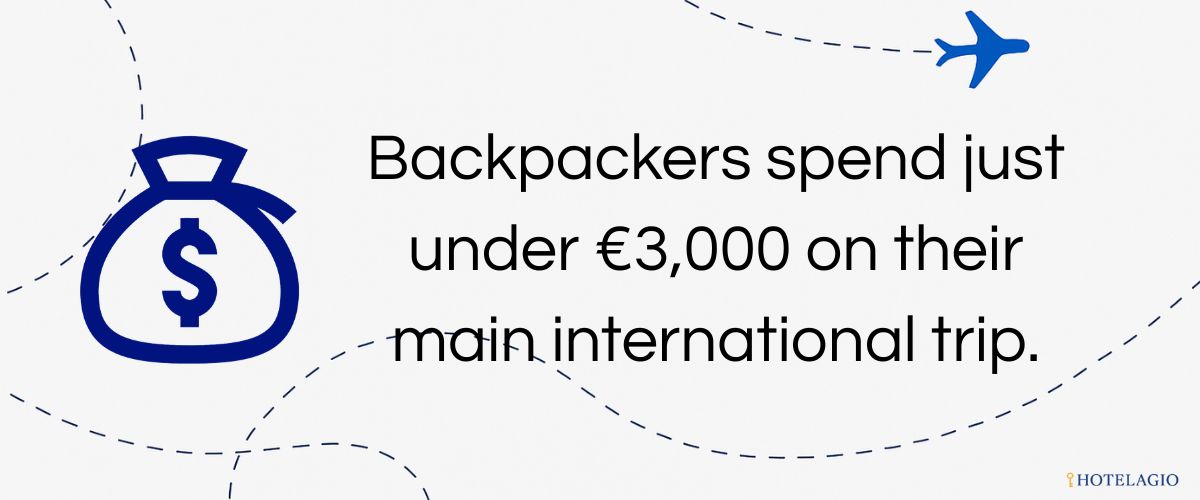
On their last main international trip, young travelers spent just under €3,000 on average, stayed a long 41 days on average, and around 69% of their trip cost was spent in-destination — money that goes straight to local economies.
Backpacker-friendly hostels are evolving too.
Hostelworld reports 85% of bookings now come from its in-app social community, with app bookings up 11% year over year in early 2025 and roughly 3 million social members engaging on the platform.
And in classic backpacker heartlands like Australia, long-stay working-holiday travelers — a strong proxy for the backpacker scene — have rebounded sharply: 170,437 Working Holiday Maker visa holders were in Australia as of June 30, 2024, with continued growth into late 2024.
Key Stats: Backpacker Tourism
- There are ~45 million backpacking trips globally each year — a substantial slice of adventurous travel activity.
- The backpacker hostel market was worth approx. USD 8.5 billion in 2023, and is expected to grow rapidly.
- Backpackers / solo travelers make up ~55% of hostel revenue share — more than half of hostel demand is in that niche.
- Most backpackers are young: ~66% are aged 20–25, making that the core age bracket.
- Once dominant in travel identity, backpacking’s share of all travellers fell from >30% in 2002 to ~14% in 2017 — though absolute numbers remained high.
- The average backpacker’s age has increased a bit — from ~23 to ~24 in recent years — reflecting a slow shift in demographics.
- A striking 80%+ of backpackers stay in hostels, embracing shared, budget-friendly lodging.
- Roughly one in three backpackers rely on reviews when selecting their hostel.
- Backpackers often travel solo: among solo backpackers, 80%+ identify as women in many surveys.
- The hostel segment is expected to expand: projected to reach USD 11+ billion by 2030.
What are the headline backpacker numbers right now?
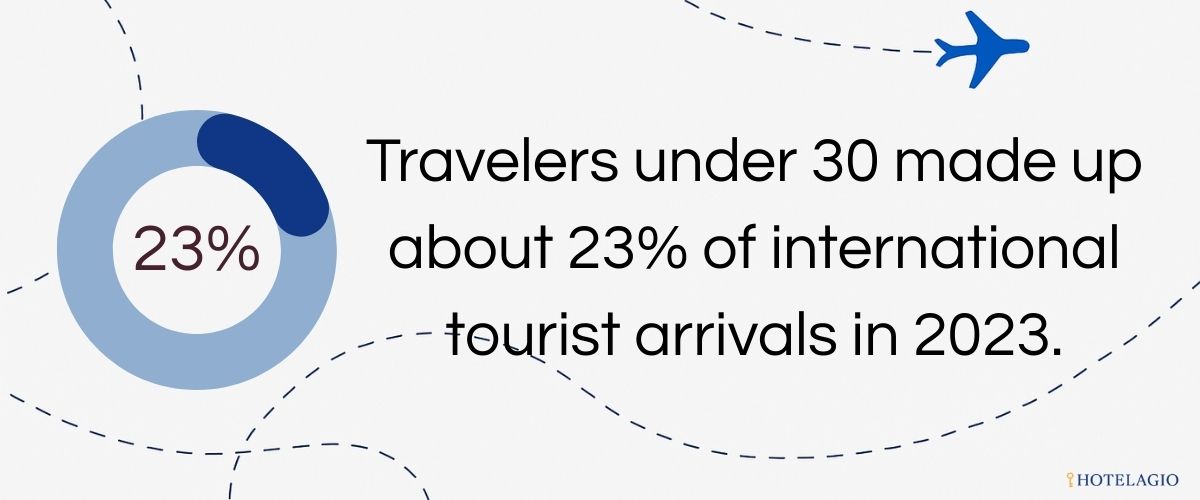
- 23% of international arrivals are youth/student travelers (under 30).
- €3,000 (just under) average spend on the last main international youth trip; 69% of spend occurs in-destination.
- 41 days average duration of the last international youth trip (down from 52 days in 2017).
- Hostelworld’s social network: ~3M members, 85% of bookings from members, +11% YoY app bookings in H1 2025.
- Working Holiday Maker (Australia): 170,437 visa holders in country as of June 30, 2024, after strong post-pandemic growth.
Youth/Backpacker Snapshot (global)
| Metric | Latest reading | Notes |
|---|---|---|
| Share of global international arrivals (under 30) | ~23% | WYSE + UN Tourism estimate, 2023 base year |
| Avg. spend, last main international youth trip | Just under €3,000 | Self-reported in WYSE New Horizons 5 |
| Share of trip cost spent in destination | ~69% | Indicates strong local economic impact |
| Avg. duration, last international youth trip | 41 days | Down from 52 days in 2017 |
Source: WYSE Travel Confederation, New Horizons 5 (2024).
How much do backpackers actually spend — and where does the money go?
Backpackers (and the broader youth cohort) aren’t necessarily high spenders per day, but they stay longer and spend most of their money locally — on hostels, intercity buses, tours, cafés, small shops, and nightlife.
The latest global youth study found ~69% of trip costs are spent in-destination — the kind of money that independent businesses feel right away. The average spend on the last main trip was just under €3,000.
Where the backpacker dollar lands (global youth proxy)
| Spending angle | Data point | Why it matters |
|---|---|---|
| In-destination share of spend | ~69% | Higher local multiplier effect vs. package travel |
| Avg. total trip spend | Just under €3,000 | Long trips translate into meaningful totals |
| Avg. trip length | 41 days | Extended stays distribute spend across regions |
Source: WYSE Travel Confederation, New Horizons 5 (2024).
Where is the backpacker scene rebounding the fastest?
Australia is a bellwether. Long-stay working-holiday travelers power hostel demand in coastal cities and regional hubs. After border reopenings, 170,437 Working Holiday Maker (WHM) visa holders were in Australia by June 30, 2024, up strongly from 2023. The program now spans 50 partner countries, with several raising the eligible age to 35 — trends that support continued backpacker flows.
Australia’s Working Holiday Maker (WHM) pulse
| Indicator | Latest figure | Date |
|---|---|---|
| WHM visa holders in Australia (total) | 170,437 | Jun 30, 2024 |
| Partner countries/regions | 50 | 2024 program settings |
| Upper age in select partners (e.g., UK, Ireland, Italy, France, Canada, Denmark) | 35 | Per program rules |
Source: Australian Dept. of Home Affairs, BR0110 Working Holiday Maker report (Dec 31, 2024).
Are hostels still the backbone of backpacker travel?
Yes — and they’re changing fast. Hostelworld’s mid-2025 update shows its social network is now core to booking behavior: 85% of bookings come from social members, app bookings rose 11% YoY, and users sent 42% more messages in the six months before June 2025, signaling stronger on-the-road communities.
There’s also a sustainability edge that matters to younger travelers: independent research with Bureau Veritas found hostels are, on average, 82% less carbon-intense (scope 1 and 2) per bed night than hotels. That’s a big deal for a segment that cares about footprint and price.
Hostel market signals (2024–2025)
| Signal | Latest reading |
|---|---|
| Share of bookings from Hostelworld social members | 85% (H1 2025) |
| App bookings growth | +11% YoY (H1 2025) |
| Social community size | ~3 million (June 2025) |
| Hostel vs. hotel carbon intensity | −82% per bed night |
Sources: Hostelworld Interim Results (July 30, 2025); Bureau Veritas (Mar 19, 2024).
How long do backpackers stay — and how is that changing?
Global youth travelers now average 41 days on their last international trip, compared with 52 days in 2017.
That’s still far longer than mainstream holidays and continues to drive demand for multi-city itineraries and flexible rail or bus passes — classic backpacker behaviors.
What’s driving destination choice in 2025?
Three simple forces:
- Affordability and work opportunities (e.g., working-holiday visas) keep Australia and parts of Europe in favor.
- Community and convenience — social features in hostel apps help solo travelers find people and plan on the fly.
- Sustainability ethos — the carbon advantage of hostels aligns with youth values without breaking the budget.
FAQ
What counts as a “backpacker” in the data?
Most countries don’t track “backpackers” as a formal category. We rely on youth travel surveys (under 30) and working-holiday visa stats as robust proxies, and we label them clearly.
Do backpackers really help local economies?
Yes. The best global measure we have shows about 69% of youth trip costs are spent in-destination, which supports small businesses directly.
Are hostels actually more sustainable than hotels?
Independent analysis suggests hostels are ~82% less carbon-intense per bed night (scope 1 and 2) than hotels.
Where can I see the latest working-holiday numbers for Australia?
The Department of Home Affairs publishes a biannual WHM report; as of June 30, 2024, 170,437 WHM visa holders were in Australia.
Sources
- WYSE Travel Confederation — New Horizons 5 study on Global Youth and Student Travel published.
- Hostelworld Group plc — 2025 Interim Results Announcement.
- Hostelworld Group plc — Preliminary Results 2024.
- Bureau Veritas — Hostels now 82% less carbon intense than hotels (Carbon Impact Analysis 2nd ed., 2024).
- Australian Department of Home Affairs — Working Holiday Maker visa program report (to 31 Dec 2024).

0 Comment