


Hotel performance has stabilized at high volumes, but growth is flatter than a year ago.
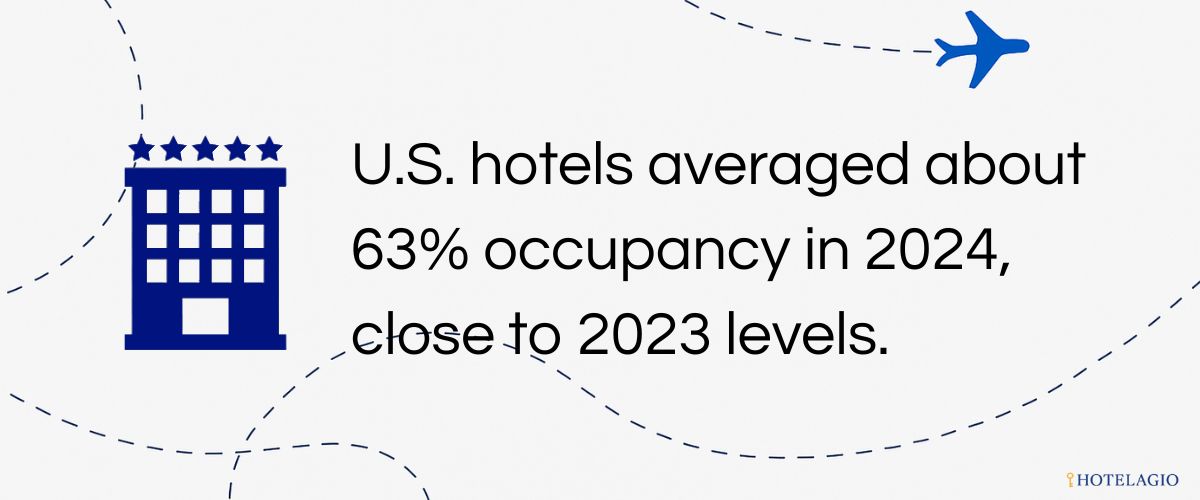
In the United States, full-year occupancy hovered near 63 percent in 2024, with industry forecasters projecting only a small uptick for 2025.
Globally, occupancy has returned close to pre-pandemic levels, though results vary by region and city.
Beach and event markets continue to outperform; budget and midscale demand has softened against tighter household budgets.
Key stats: Hotel Occupancy Rates
- U.S. hotels averaged ~53.2 % occupancy in December 2024, showing moderate recovery in off-peak season.
- In peak months (e.g. July 2025), occupancy in top U.S. markets reached ~68.2 %.
- But in some weeks in 2025, occupancies dipped—for instance, 65.4 % for the week ending Sept 13.
- Globally, 2023 occupancy hovered around 69 %, though this varies strongly by region and season.
- Urban hotels globally average ~54 % occupancy per CBRE, while resort/beach destinations often outperform that.
- In Mexico, coastal destinations like Cancún saw occupancy as high as 74 % in 2024.
- U.S. average occupancy in 2024 is projected around 63 %, still a few points shy of the 2019 pre-pandemic average of ~66.9 %.
- For 2025, the U.S. lodging sector expects occupancy to reach ~63.38 %, nearly closing the gap to 2019 levels.
What are the key hotel occupancy numbers right now?
- U.S. average occupancy (actual): 2024 finished at roughly 63.0 percent, similar to 2023. Forecast for 2025: 63.38 percent. 2019 benchmark: 65.80 percent.
- U.S. monthly example: December 2024 occupancy was 53.2 percent; New York City led major markets at 87.9 percent for the month.
- U.S. peak season example: July 2024 occupancy reached 68.8 percent.
- Global lens: CBRE reported total average occupancy at 60.3 percent in May 2024, less than one percentage point below 2019.
- Outlook pressure point: CoStar noted weaker demand from lower-income travelers in 2024 and trimmed U.S. occupancy expectations slightly to about 62.8 percent in one mid-year view.
How is U.S. occupancy trending in 2024–2025?
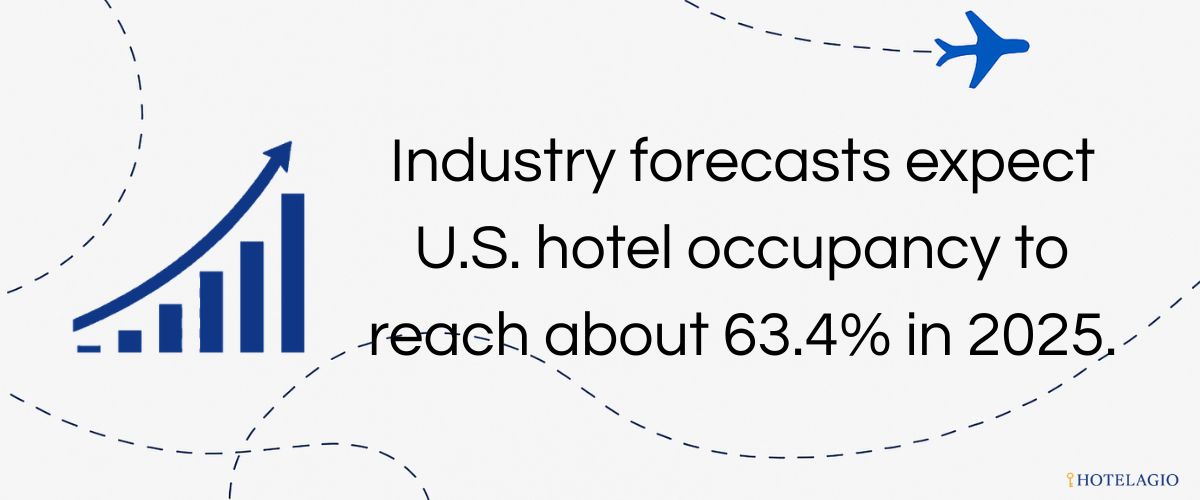
The American market is steady but not surging. AHLA’s 2025 State of the Industry report, using STR and Oxford Economics inputs, shows 2024 occupancy at 63.01 percent and a 2025 projection of 63.38 percent, still shy of 2019’s 65.80 percent. Translation: rates (ADR) and total revenue (RevPAR) are carrying more of the growth than occupancy.
Seasonality still matters. STR’s monthly readouts show midsummer as the occupancy high point and shoulder/holiday periods as softer, with December 2024 coming in at 53.2 percent. Market mix is crucial: New York City posted 87.9 percent occupancy in December, while markets like Minneapolis and Detroit trailed below 50 percent.
How does global occupancy compare?
By mid-2024, CBRE put global average occupancy at 60.3 percent, within a point of pre-COVID norms, with beach destinations in Mexico far above average.
Europe and parts of Asia posted solid RevPAR on the back of strong rates; occupancy growth is harder where levels are already high or comps are event-heavy.
Country and city outcomes differ: Southern Europe’s 2024 RevPAR rose nearly 10 percent, while Amsterdam’s annual occupancy edged up to 75.7 percent amid pricing pressure.
Which markets are outperforming or lagging?
- Outperformers: Big leisure and gateway markets. In December 2024, New York City topped major U.S. markets at 87.9 percent. Mexican beach destinations such as Cancun and Los Cabos reported well above average occupancy in May 2024.
- Mixed results: Western Europe’s large capitals face very high base occupancy and overtourism pressures, making further occupancy gains harder, with performance relying more on rate management.
- Pressure points: U.S. midscale and economy demand softened in 2024 as lower-income travelers pulled back, contributing to slightly weaker occupancy forecasts.
U.S. Occupancy Benchmarks
| Year | U.S. Average Occupancy |
|---|---|
| 2019 | 65.80% |
| 2023 | 62.97% |
| 2024 | 63.01% |
| 2025 (projected) | 63.38% |
Source: AHLA 2025 State of the Industry (STR and Oxford Economics input).
Selected Monthly Readouts (U.S.)
| Month / Metric | Occupancy |
|---|---|
| July 2024 (national) | 68.8% |
| December 2024 (national) | 53.2% |
| December 2024 (New York City) | 87.9% |
Source: STR press releases and monthly commentary.
Global Context
| Indicator | Latest datapoint |
|---|---|
| Global average occupancy (May 2024) | 60.3% |
| Note on regions | Southern Europe’s 2024 RevPAR up 9.8% YoY; Amsterdam annual occupancy 75.7% with pricing pressure |
Sources: CBRE Global Midyear Hotels Outlook 2024; STR Europe updates.
What defines occupancy and why it still matters
Occupancy is the share of available rooms sold. In a flat-growth year, operators rely more on rate strategy and mix to grow RevPAR. But occupancy still signals health: higher base occupancy supports group business, food and beverage capture, and compresses demand on peak nights, which in turn helps rates.
What to watch for in the next 12 months
- Business travel pace. Weekday demand in some U.S. markets remains softer than leisure peaks. Sustained corporate and group pickup would be a tailwind.
- Price sensitivity in midscale and economy. If household budgets stay tight, occupancy could drift lower outside top leisure and event markets.
- Big-event comps. Markets with large 2024 events face tougher year-over-year occupancy comparisons; performance may shift to ADR management rather than volume increases.
FAQ: Hotel occupancy rates
What is the current U.S. average occupancy
The U.S. finished 2024 at about 63 percent, with a 2025 projection of roughly 63.4 percent. That is still below 2019’s 65.8 percent.
Which U.S. markets are running the hottest
It changes by month, but in December 2024 New York City posted 87.9 percent occupancy, well above the national level.
How close is global occupancy to pre-pandemic norms
CBRE’s mid-2024 read put global occupancy at 60.3 percent, less than one percentage point below 2019.
Why are some hotels still missing pre-2019 occupancy
Slower recovery in certain demand segments, tighter household budgets in lower price tiers, and very high base occupancy in major European cities make further gains harder.
Sources
- American Hotel & Lodging Association — 2025 State of the Industry Report
- STR — U.S. Hotel Performance: December 2024
- STR — U.S. Hotel Performance: July 2024
- STR Data Insights — U.S. Hotel Commentary: December 2024
- CBRE — 2024 Global Midyear Hotels Outlook
- STR via HospitalityNet — Europe Hotel Performance Update (June 2025)
- STR Data Insights — Europe Hotel Performance Updates
- STR Data Insights — Southern Europe Hotel Performance Update
- Reuters — Lower-income Americans booked fewer hotels in April, dampening outlook

0 Comment