


Rural travel is having a moment. In the European Union, nearly one-third of all tourist nights (32.7%) in 2024 were spent in rural areas — essentially neck-and-neck with cities and towns.
In the United States, agritourism income reached $1.26 billion in 2022, and the broader outdoor recreation economy (much of it in rural places) delivered $639.5 billion in value added in 2023.
Key stats: Rural Tourism
- The global rural tourism market is expected to be worth USD 118 billion in 2025, climbing to nearly USD 193 billion by 2032.
- Historical growth is strong: from ~USD 91 billion in 2023 to ~USD 97.8 billion in 2024, heading toward USD 131.5 billion by 2028.
- Agritourism (on-farm stays, farm visits) stands out as a fast-growing sub-sector: ~$8.1 billion in 2024, growing at ~11.9 % annually.
- Despite its importance, less than 30 % of UNWTO member states report rural-specific visitor data, making comprehensive comparisons hard.
- In rural destinations, accessibility, open views, and cultural heritage features (old buildings, trees) strongly influence tourist flow.
- Success in rural tourism often hinges on infrastructure, local community involvement, authenticity, and digital connectivity.
What are the key rural tourism stats right now?
- EU split of nights by place type (2023): towns/suburbs 33.8%, cities 33.5%, rural areas 32.7% — a balanced map of where visitors actually sleep.
- U.S. agritourism revenue (2022): $1.26 billion, up 12.4% vs. 2017 (inflation-adjusted). 57% of U.S. counties reported some agritourism income.
- U.S. outdoor recreation economy (2023): $639.5 billion value added (2.3% of GDP).
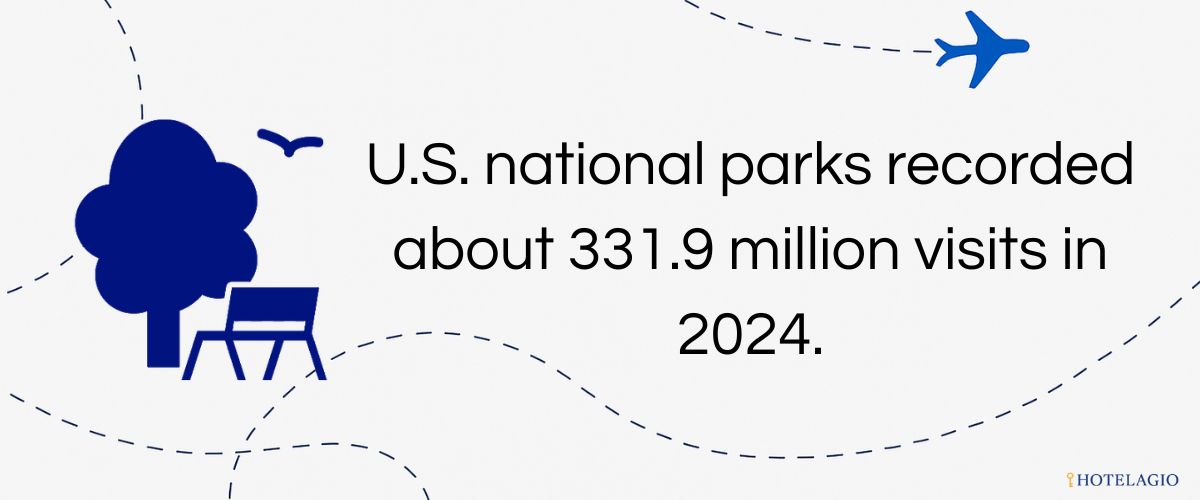
- U.S. National Parks (2024): 331.9 million visits (record), $29 billion spent in gateway towns, $56.3 billion total economic output.
- UN Tourism Best Tourism Villages (2024): 55 villages recognized from 60+ countries; network now 186 members (recognized + upgrade).
How big is rural tourism globally (and is it still growing)?
There isn’t a single global “rural tourism” ledger, but multiple indicators point to strong and steady demand:
- EU trend: Overnight stays hit new highs through 2025, and rural areas consistently account for about one-third of all nights. In H1 2025, total EU overnights rose 2.3% year-over-year to 1.279 billion.
- Nature-based travel as a proxy: Protected areas around the world draw ~8 billion visits a year — much of this occurs in rural landscapes and small towns.
- Market lenses: Private market analysts peg “rural tourism” globally at ~$118 billion in 2025, projecting a ~7% CAGR through 2032 (methodologies vary; treat as directional).
Takeaway: Whether you measure by nights (EU), spend and jobs (U.S.), or visits to protected areas (global), the rural slice of travel is large — and resilient.
What does rural tourism look like in the U.S. economy?
Two big windows onto rural demand:
- Agritourism on working lands
U.S. farms and ranches reported $1.26 billion in 2022 agritourism income, with more than half of counties (57%) participating. Top-earning counties were widely distributed across 23 states — not just the usual suspects. - Outdoor recreation & parks (often rural)
The outdoor recreation economy contributed $639.5 billion in value added in 2023 (2.3% of U.S. GDP). National parks then layered on a record 331.9 million visits in 2024, $29 billion in visitor spending, and $56.3 billion in total economic output — critical lifeblood for gateway communities.
“Tourism in rural areas can play a pivotal role in supporting rural economies through income diversification of farmers and job creation.”
— QU Dongyu, Director-General, FAO (2020).
“Ultimately, nature-based tourism is a triple win: It protects biodiversity, creates meaningful jobs, and generates strong economic returns.”
— Juergen Voegele, Vice President for the Planet, World Bank (2025).
U.S. quick table (latest)
| Indicator | Latest datapoint |
|---|---|
| Agritourism income | $1.26 B (2022) |
| Counties with agritourism | 57% |
| Outdoor recreation value added | $639.5 B (2023) |
| National park visits | 331.9 M (2024) |
| Visitor spend near parks | $29 B (2024) |
Sources: USDA ERS (Census of Agriculture analysis), BEA ORSA, NPS.
How is rural tourism performing in Europe?
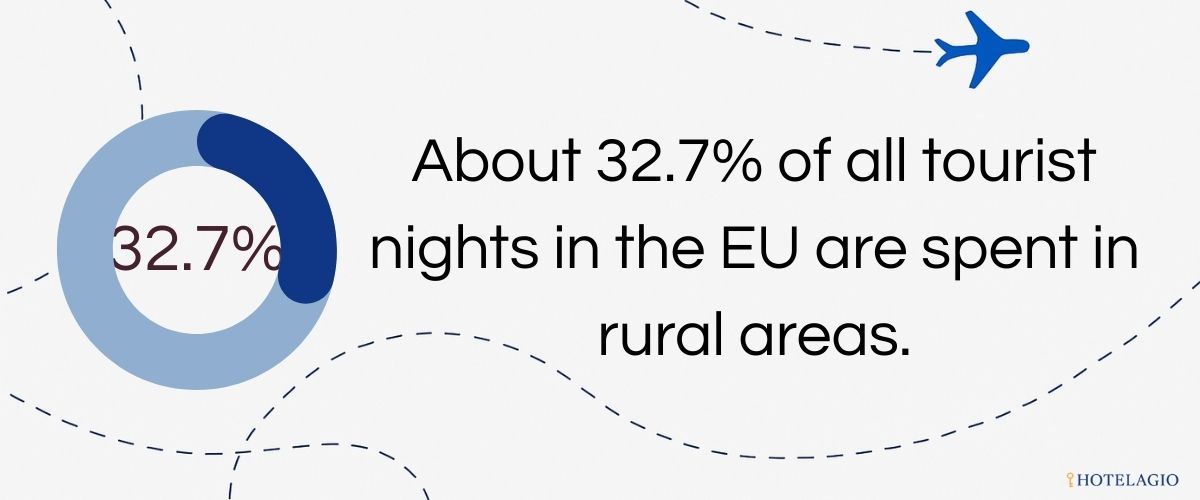
- Where nights happen: In 2023, EU nights were spread almost evenly: towns/suburbs 33.8%, cities 33.5%, rural 32.7%. In other words, rural stays are not a niche.
- Momentum: EU accommodation nights set records into 2025 H1 (+2.3% year-over-year). Country data show rural sub-segments (e.g., Spain’s “turismo rural”) growing faster than average in peak months — +5.6% YoY rural overnights in Spain, July 2025.
EU at a glance
| Metric | 2023/2025 |
|---|---|
| Share of nights in rural areas | 32.7% (2023) |
| Total EU nights, H1 | 1.279 B (2025, +2.3% YoY) |
| Spain rural stays, July | +5.6% YoY (2025) |
Sources: Eurostat; INE Spain.
Are rural destinations getting new visibility?
Yes — one clear signal is UN Tourism’s Best Tourism Villages program, which showcases rural communities with strong cultural and environmental stewardship:
- 55 villages recognized in 2024 (the 4th edition), selected from 260+ applications across 60+ countries.
- The broader network now counts 186 members (recognized villages + “Upgrade Programme” participants), spanning 55 countries.
This recognition often translates into more awareness and investment — and a playbook for sustainable growth (heritage preservation, agrifood value chains, and small-business development).
What’s driving rural travel demand (and what holds it back)?
Drivers:
- Nature & open space, parks & trails, water access, wildlife viewing, farm/food culture, and small-town festivals. Outdoor recreation data confirm the spending power behind these motivations.
Constraints:
- Infrastructure gaps (transport, digital connectivity), seasonality, limited workforce/skills, and occasionally over-use in hotspots without visitor management. (EU and UN Tourism briefs call out these issues and recommend route networks, capacity management, and quality standards.)
“At-a-glance” rural tourism numbers (latest available)
| Segment | Number | Why it matters |
|---|---|---|
| EU nights in rural areas (share, 2023) | 32.7% | Rural isn’t niche — it’s a third of the market. |
| U.S. agritourism revenue (2022) | $1.26 B | Direct dollars on farms/ranches; broad county participation. |
| U.S. outdoor recreation (2023) | $639.5 B (2.3% GDP) | Big rural spend driver beyond cities. |
| U.S. national parks (2024) | 331.9 M visits; $29 B spend | Fills rural gateway economies; $56.3 B output. |
| UN Tourism Best Tourism Villages (2024) | 55 new; 186 total network | Signals global momentum for rural destinations. |
FAQ: Rural Tourism
What exactly counts as “rural tourism”?
Travel to non-urban places — villages, countryside, protected areas — often centered on nature, heritage, food/farm experiences, and outdoor recreation.
Is rural tourism really growing?
Yes. EU nights keep setting records, rural shares remain ~one-third, and U.S. indicators (agritourism, outdoor recreation, parks) show strong spending.
How big is the U.S. rural opportunity?
Agritourism alone tops $1.26 B, while outdoor recreation’s $639.5 B value-added footprint powers many rural economies — plus park-gateway spending.
Which rural places are trending globally?
UN Tourism’s Best Tourism Villages list grows yearly (2024 added 55), giving travelers a vetted, sustainable shortlist of small-town destinations.
Which rural places are trending globally?
UN Tourism’s Best Tourism Villages list grows yearly (2024 added 55), giving travelers a vetted, sustainable shortlist of small-town destinations.
“Tourism is a vital tool for inclusion, empowering rural communities to protect and value their rich cultural heritage while driving sustainable development.”
— Zurab Pololikashvili, Secretary-General, UN Tourism (2024).
Sources
- Eurostat — Nights by degree of urbanization (2023 split)
- Eurostat — Tourism nights in the EU, first half of 2025
- USDA ERS — Agritourism income from the 2022 Census of Agriculture
- BEA — Outdoor Recreation Satellite Account, U.S. and States, 2023
- National Park Service — 2024 Visits & Economic Contributions to Communities and 2024 Visitor Spending Effects
- UN Tourism — Best Tourism Villages 2024 (55 villages) and Network size & membership
- UN Tourism — Tourism for Rural Development Programme (Impact Report hub)
- World Bank — Nature-Based Tourism (2025 brief)
- INE Spain — Non-hotel accommodation survey (includes rural tourism) – July 2025

0 Comment