


Wildlife tourism is big, and it’s getting bigger.
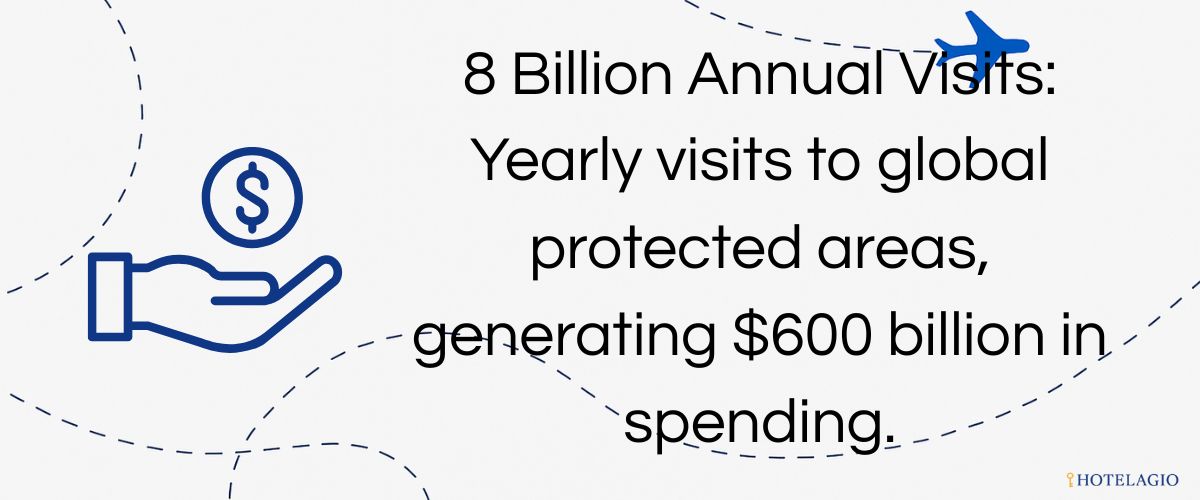
Around the world, protected areas draw about 8 billion visits a year, generating hundreds of billions of dollars in spending — far more than what’s invested to maintain them.
In the U.S., wildlife watching (everything from birding to photographing bison) drove $250.2 billion in consumer spending in 2022, supporting 2.74 million jobs.
Whale watching alone attracts 13+ million people a year across roughly 120 countries.
Key stats: Wildlife Tourism
- USD 154.6 billion in 2022 — that’s the approximate size of the global wildlife tourism market.
- It’s projected to nearly double by 2030, reaching USD 286.9 billion at ~7.9% annual growth.
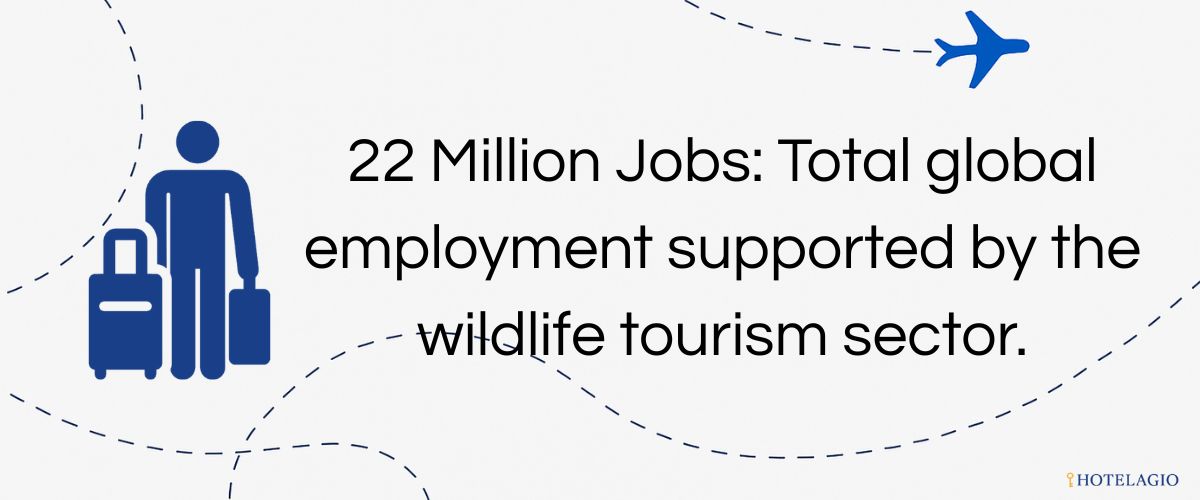
- Wildlife tourism supports 22 million jobs worldwide, directly or indirectly.
- It contributes about USD 120 billion to global GDP — ~4.4% of the direct tourism GDP slice.
- Nature tourism (of which wildlife is a key part) is valued at ~USD 600 billion annually across protected areas.
- Asia Pacific dominates the revenue share (~50.7% in 2022), though Africa & Middle East are among the fastest growing.
- Tourism pressure is not benign: 5,930 species globally face risks from recreation pressures.
- In zones with heavy foot traffic (8–37 visitors/ha), wildlife counts (e.g. bird diversity) decline markedly.
- Many wildlife tourism experiences (safaris, guided tours) harm animal welfare or conservation if poorly managed.
- Protected areas: ~8 billion visits annually; studies estimate ~$600 billion in tourism expenditure tied to parks and reserves in a typical year.
- United States (all wildlife watching, 2022): 148.3 million participants; $250.2 billion in direct spending; $590.3 billion in total output; 2.74 million jobs; $60.1 billion in state & federal tax revenue.
- U.S. national parks (2024): 331.9 million visits (record), $29 billion in gateway-community spending, $56.3 billion added to the U.S. economy.
- Whale watching (global): 13+ million participants yearly; industry present in ~120 countries/territories.
- African safaris (market lens): $34.6 billion market in 2023, projected $51.5 billion by 2030 (CAGR ~6.1%).
Note: “Wildlife tourism” can be defined narrowly (wildlife viewing experiences) or broadly (all nature-based trips). Methodologies differ; where possible, I’ve paired recent sources with clearly dated baselines.
“Our message to tourism businesses, employees and visitors across the globe is that wildlife is worth far more alive than dead.”
— Gloria Guevara, President & CEO, WTTC.
How big is wildlife tourism globally (and how fast is it growing)?
Analyses converge on two realities: huge volume and durable demand.
A landmark multi-author study modeled ~8 billion annual visits to protected areas — and roughly $600 billion in related spending — even before today’s rebound.
Fresh 2025 briefs from the World Bank continue to cite ~8 billion protected-area visits as a reference point for nature-based tourism.
“Now we’ve shown that through tourism nature reserves contribute in a big way to the global economy.”
— Prof. Andrew Balmford, University of Cambridge.
“Our US$600 billion figure for the annual value of protected area tourism is likely to be an underestimate.”
— Dr Robin Naidoo, World Wildlife Fund.
For a global “wildlife-specific” slice, WTTC’s pre-pandemic assessment (with Oxford Economics) put wildlife tourism’s direct GDP at ~$120.1 billion and 9.1 million jobs, with a total (direct + indirect + induced) footprint of ~$343.6 billion.
Treat these as baseline magnitudes; the rebound in 2024-2025 suggests a return toward — and in some regions beyond — those levels.
How big is wildlife watching in the United States?
The latest federal deep-dive (U.S. Fish & Wildlife Service) shows the scale:
U.S. Wildlife Watching, 2022 (most recent full accounting)
| Metric | Result |
|---|---|
| Participants (age 16+) | 148.3 million |
| Direct consumer spending | $250.2 billion |
| Total economic output | $590.3 billion |
| Jobs supported | 2,742,010 |
| Total tax revenue | $60.1 billion |
Source: USFWS “2022 Economic Contributions of Wildlife Watching in the U.S.”
And America’s national parks — many of them wildlife magnets — posted a record 331.9 million visits in 2024, with $29 billion in spending near park gateways and $56.3 billion in economic contribution.
How popular (and valuable) is marine wildlife tourism?
Whale watching remains one of the most organized forms of wildlife tourism:
- 13+ million people go whale watching annually; the activity occurs in ~120 countries and territories.
- Industry estimates commonly place global whale-watching value in the $2–3 billion range, depending on scope and year. (Ranges summarized across conservation and trade sources.)
For best practice, regulators and NGOs stress minimum approach distances, speed limits, and no-wake rules to reduce disturbance — a point echoed by the International Whaling Commission’s Whale Watching Handbook.
What about safaris and wildlife watching in Africa?
Wildlife is a primary draw: UN Tourism research has long indicated that ~80% of annual trip sales to Africa involve wildlife watching (older but still widely referenced).
Meanwhile, market analysts size safari tourism at $34.6 billion (2023) with steady growth into 2030.
Why this matters: demand for big-game viewing concentrates benefits — and pressures — in reserves and conservancies.
Sustainable management and anti-poaching funding are essential to keep nature — and local economies — thriving.
“Poaching is not only destroying precious ecosystems, it also poses a serious threat to socio-economic development.”
— Taleb Rifai, former Secretary-General, UNWTO.
Do specific ecosystems move the needle?
Yes. Coral reefs are a standout example:
- Global coral-reef tourism is valued at about $36 billion per year, with roughly 30% of the world’s reefs contributing to tourism value.
These values underscore why climate resilience and reef recovery programs are economic issues — not just environmental ones.
Quick table: “At-a-glance” wildlife tourism figures (latest available)
| Segment | Latest datapoint | Source |
|---|---|---|
| Protected-area visits (global) | ~8 billion visits/yr; ~$600 billion spending | Balmford et al.; UNEP-WCMC/WWF summaries. |
| Wildlife tourism (global, baseline) | $120.1 billion direct GDP; 9.1 million jobs | WTTC/Oxford Economics (pre-COVID baseline). |
| U.S. wildlife watching (2022) | $250.2 billion spend; 2.74 million jobs | USFWS economic contributions report. |
| U.S. national parks (2024) | 331.9 million visits; $29 billion gateway spend | NPS 2024 record visitation summary. |
| Whale watching (global) | 13+ million participants; ~120 countries | WDC 2024 guide. |
| Safari tourism (market) | $34.6 billion (2023) → $51.5 billion (2030) | Grand View Research. |
| Coral-reef tourism (global) | $36 billion/yr | Spalding et al., Marine Policy; GCRMN. |
Are there risks — and what counts as “responsible” wildlife tourism?
Yes. Poorly managed wildlife encounters can disturb behavior, reduce breeding success, or cause injuries.
Good management balances visitor experience with animal welfare: keep distances, limit boat numbers and speeds, avoid nesting/denning areas, and follow local permit rules.
For marine wildlife, the IWC’s Whale Watching Handbook and NGO guides are practical starting points for operators and travelers alike.
“Private investment and know-how are needed to develop attractive tourism services and products.”
— Doreen Robinson, Chief of Wildlife, UNEP.
Wildlife Tourism FAQ
Is wildlife tourism back to pre-pandemic scale?
Overall nature-based visitation is robust again; ~8 billion protected-area visits remains the commonly cited magnitude, with many regions at or above 2019 levels.
How big is wildlife watching in America, economically?
In 2022, Americans spent $250.2 billion on wildlife watching; that activity supported 2.74 million jobs and $60.1 billion in tax revenue.
How many people go whale watching?
More than 13 million annually, across ~120 countries. Pick certified or guideline-compliant operators to reduce disturbance.
What’s the single best “quick stat” for policymakers?
Protected-area tourism may generate ~$600 billion per year, compared with < $10 billion spent annually to manage them — a massive ROI case for funding parks.
Sources
- World Bank — Nature-Based Tourism (2025 brief)
- PNAS / University of Cambridge — Estimating the Global Magnitude of Visits to Protected Areas
- UNEP-WCMC / WWF summary — Protected areas receive eight billion visits a year
- U.S. Fish & Wildlife Service — 2022 Economic Contributions of Wildlife Watching in the U.S.
- U.S. National Park Service — Economic Contributions to Communities (2024 visitation)
- Whale & Dolphin Conservation — Responsible Whale Watching Guide 2024
- International Whaling Commission — Whale Watching Handbook: Responsible Management
- Grand View Research — Safari Tourism Market Size, Share & Trends
- WTTC / Oxford Economics — Global Economic Impact of Wildlife Tourism (2018 baseline)
- Marine Policy (Spalding et al.) — Global Value & Distribution of Coral-Reef Tourism
- GCRMN — Status of Coral Reefs of the World 2020
- UN Tourism / UNWTO — Wildlife Watching Tourism in Africa (briefing paper)

0 Comment