


Online reviews now sit at the center of trip planning.
In 2024 alone, travelers posted 31.1 million reviews on Tripadvisor and uploaded 38.1 million photos and videos.
Tripadvisor also removed 2.7 million fraudulent reviews and flagged 214,000 AI-generated submissions, underscoring how important trust has become.
What do reviews actually change? A lot.
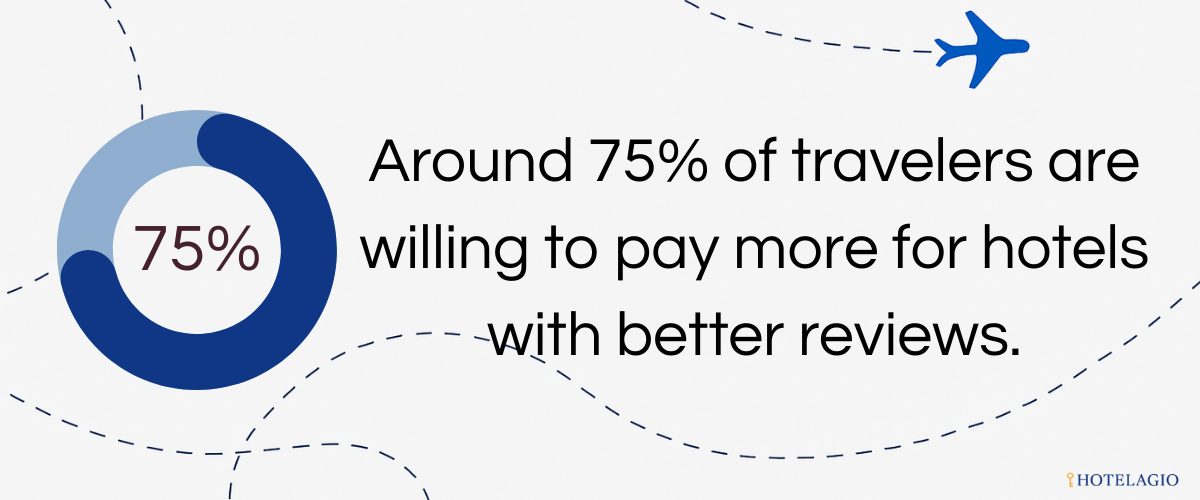
Expedia Group’s 2025 Traveler Value Index found that three-quarters of travelers are willing to pay more for lodging with better reviews; among travelers under 40, that share rises to 80 percent.
Below are the most useful, up-to-date statistics on the impact of online travel reviews, with practical takeaways you can use.
Key stats: Impact of Online Travel Reviews
- 95% of travelers read reviews before booking, and 93% say those reviews influence their decisions.
- 70.9% of travelers admit that a property’s online reputation affects their choice of accommodation.
- 81% always check reviews for hotels before making a reservation.
- 86% would skip a great deal if a business has many unresolved negative reviews.
- Reviews are most powerful in accommodation decisions, rather than mid-trip changes.
- 65% of users believe peer reviews are more up-to-date than provider descriptions, and ~61% see them as more reliable and enjoyable.
- Overall rating has the strongest effect on booking intention, though review volume still adds persuasive weight.
- On platforms like Yelp, up to 8% of reviews shift classification over time — algorithms matter.
- Travelers posted nearly 80 million contributions on Tripadvisor in 2024, including 31.1 million reviews; 2.7 million fraudulent reviews were removed.
- Three-quarters of travelers are willing to pay more for lodging with better reviews; for those under 40, it is 80 percent.
- Given equal price, travelers are 3.9 times more likely to choose a hotel with a higher review score, based on an NYU-supported experiment using simulated booking engines.
- Hotels that respond to reviews are more likely to drive booking inquiries on Tripadvisor. A classic study found a 21 percent lift when properties respond, and a further lift when they respond to more than half of reviews.
How do reviews shift willingness to pay and conversion?
Two consistent effects show up across recent research: better scores raise willingness to pay, and they improve the odds of selection.
- Expedia Group reports that three-quarters of travelers will pay more for lodging with better reviews; among travelers under 40, 80 percent say the same.
- In controlled tests run with an academic partner, TrustYou found that, at the same price, travelers are 3.9 times more likely to choose the higher-rated hotel.
- Review-driven reputation also correlates with core KPIs. Industry analysis summarizing Cornell work shows that a one-point increase in a property’s Global Review Index aligns with higher ADR, occupancy, and RevPAR.
Why it matters: Reviews do not just nudge preferences. They change revenue math in measurable ways, affecting both price tolerance and conversion at the point of booking.
Do responses to reviews actually change traveler behavior?
Yes. Management responses remain one of the simplest ways to influence shopper confidence and intent.
- Tripadvisor’s study on booking inquiries found that hotels responding to reviews are 21 percent more likely to receive a booking inquiry than those that do not respond; responding to more than half of reviews increases the lift. Although the study is older, it is still referenced across industry guidance.
- Tripadvisor’s business guidance page, citing Phocuswright, notes that thoughtful responses improve impressions and make users more likely to book compared with a comparable hotel that does not respond.
Practical takeaway: Respond consistently and personally, especially to negative reviews. The benefits show up in both engagement and booking intent.
How many reviews do people consult, and where?
Habits vary by traveler, but most shoppers do not rely on a single site.
- BrightLocal’s 2025 consumer review survey (cross-industry but highly relevant to travel) shows only 27 percent of consumers use a single website for reviews before deciding; 74 percent use two or more. This highlights the importance of consistency across platforms.
- Tripadvisor’s own 2025 Transparency Report confirms continued growth in reviews and owner responses, signaling that travelers have ample fresh signals to compare.
Practical takeaway: Keep listings accurate and reputations strong on at least two major surfaces where your audience shops, such as Google, OTAs, and Tripadvisor.
What about fake or AI-generated reviews?
Trust is a live issue, and platforms are publishing transparency data.
- Tripadvisor says it removed 2.7 million fraudulent reviews in 2024 and flagged 214,000 AI-generated reviews, while also joining the Coalition for Trusted Reviews with Amazon, Expedia Group, Booking.com, and others.
Practical takeaway: Treat review integrity as part of revenue protection. Encourage authentic, verifiable reviews and avoid any incentivization that violates platform rules.
Review impact at a glance
| Impact area | Latest datapoint |
|---|---|
| Willingness to pay | 75% of travelers will pay more for lodging with better reviews; 80% among under-40s |
| Choice probability | 3.9x more likely to select higher-rated hotel at equal price |
| Revenue correlation | +0.89% ADR, +0.54% occupancy, +1.42% RevPAR per one-point GRI increase |
| Effect of responding | +21% likelihood of a booking inquiry when management responds to reviews (and higher with frequent responses) |
| Review volume and integrity | 31.1M reviews posted in 2024; 2.7M fraudulent reviews removed; 214k AI-generated reviews removed |
FAQ
Do better reviews really let a hotel charge more?
Yes. Expedia Group finds three-quarters of travelers will pay more for lodging with better reviews. Experimental work shows shoppers pick higher-rated options far more often at the same price.
How big is the revenue effect from reputation scores?
Analyses summarizing Cornell’s research link a one-point increase in a hotel’s reputation index with higher ADR, occupancy, and RevPAR.
Should we reply to every review?
Responding is associated with more booking inquiries on Tripadvisor, especially when you reply to a large share of reviews. Keep responses timely and specific.
How worried should we be about fake reviews?
Platforms are removing large volumes, including AI-generated submissions. Treat authenticity as a must-have and follow each site’s rules to the letter.
Sources
- Expedia Group Newsroom — Expedia Group’s 2025 Traveler Value Index Signals a Shift in Consumer Priorities
- Expedia Group (Partner Hub) — 2025 Traveler Value Index | 2025 Traveler Value Index: Highlights
- Tripadvisor — Transparency Report 2025 | Tripadvisor’s 2025 Transparency Report Reveals Strong Review Submissions and Improved Fraud Detection
- TrustYou — Do Reviews Have An Impact on Hotel Conversion Rates and Pricing? | Report: The Effect of Reviews on Hotel Conversion Rates and Pricing
- Cornell University (PDF) — The Impact of Social Media on Lodging Performance
- Shiji Group Insights — The Impact of Online Reputation on Hotel Revenue
- BrightLocal — Local Consumer Review Survey 2025 | The State of Reviews 2025: Survey Breakdown
- Tripadvisor Investor Relations — Responding to Reviews Online Drives Booking Inquiries, Tripadvisor Study Reveals

0 Comment