

Travel agencies have undergone one of the most significant transformations in the tourism sector.
After the disruption of 2020–2021, the industry has not only recovered but surpassed previous benchmarks.
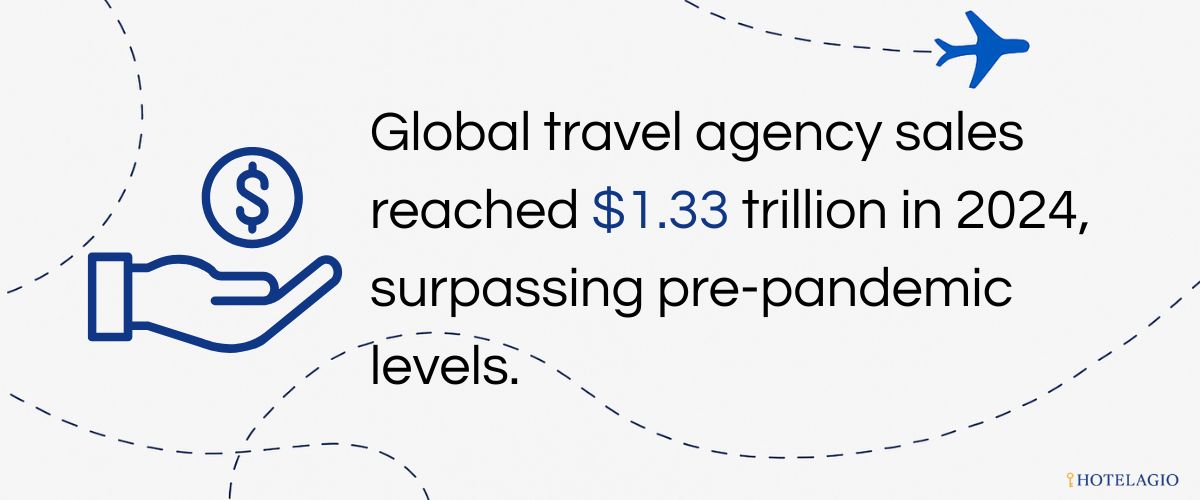
In 2024, global travel agency sales exceeded 1.33 trillion USD, driven by renewed consumer trust, higher demand for expert guidance, and the rapid growth of online booking platforms.
At the same time, brick-and-mortar agencies, independent advisors, and hybrid models are expanding as travelers seek personalized service, clarity on regulations, and curated itineraries.
Data from multiple markets shows that nearly 76 percent of consumers value professional support when planning a trip, even if they ultimately book online.
Key stats for travel agencies
- The global travel agency industry is now worth around 355 billion dollars in annual revenue, underlining how important agents still are in a world of online booking.
- There are an estimated 538,000 travel agency businesses worldwide, showing how fragmented and competitive the market remains.
- In 2024, US based travel agencies sold about 99.2 billion dollars in air tickets, the highest level ever recorded by ARC and even above pre pandemic records.
- In 2023, US travel agencies already handled 95.3 billion dollars in air ticket sales, up 16 percent year over year, confirming a strong rebound in agency driven air travel.
- The global online travel agencies market is huge on its own, estimated at around 613 billion dollars in 2024, with forecasts to pass 1 trillion dollars by 2030, powered by smartphones, self service booking and dynamic pricing.
- Online booking clearly dominates traveler behavior, with around 70 percent of global travel and tourism bookings now made online, including through OTAs and direct brand sites, while traditional offline channels account for the minority.
- In consumer surveys, roughly 72 percent of travelers say they prefer to book trips online, and only about 12 percent say they still prefer to book through a traditional travel agency, highlighting the pressure on brick and mortar agents to reinvent themselves.
- Despite that shift, the number of specialist agencies and boutiques remains significant. In the UK alone, the travel agency market was worth around 29.4 billion pounds in 2024, with about 5,000 agency businesses operating in the sector.
- Package holidays are making a comeback. In the UK market, spending through travel agents has been growing faster than overall travel spending, with bookings through agents up about 11 percent year over year, as travelers look for protection and hand holding.
- Analysts expect package travel sold via agents in markets like the UK, Ireland and Germany to keep growing at roughly 8 percent a year to reach around 67 billion pounds by 2028, showing that curated and protected trips still have strong appeal.
- Overall, offline agencies are estimated to handle only around 15 percent of bookings, while online platforms capture about 85 percent, but many travelers still turn to human agents for complex itineraries, group trips and high ticket journeys.
How Many Travelers Use Travel Agencies?
A growing number of travelers rely on travel agents or advisors for at least part of their trip planning.
Key usage statistics include:
- Approximately 40 to 45 percent of global leisure travelers used a travel agency or advisor in 2024, up from 27 percent in 2019.
- Among high-income travelers, usage rises to over 60 percent.
- In corporate travel, around 80 percent of bookings still pass through a managed travel agency or TMC.
- Millennials and Gen Z travelers are increasingly turning to agencies, with 38 to 42 percent saying they prefer having an expert plan complex itineraries.
Travel agents remain highly relevant, especially for multistep travel, luxury travel, cruises, and international trips.
How Much Revenue Do Travel Agencies Generate?
Global travel agency revenue continues to rise as demand for travel rebounds and diversifies.
- Total global agency sales in 2024 reached approximately 1.33 trillion USD.
- U.S. travel agency revenue alone exceeded 146 billion USD.
- Corporate travel booking revenue has returned to nearly 90 percent of pre-pandemic levels.
- Cruise bookings through travel agencies rose by 52 percent between 2022 and 2024.
- Independent travel advisors report yearly sales increases of 15 to 25 percent.
The revenue surge reflects both renewed consumer confidence and the complexity of modern travel planning.
What Types of Travel Agencies Are Growing the Fastest?
The travel agency landscape has evolved into several dominant models.
| Agency Type | Growth Trend (2023–25) | Notes |
|---|---|---|
| Online Travel Agencies (OTAs) | 8–12% annually | Continues to dominate mass-market bookings |
| Independent Travel Advisors | 15–25% annually | High personalization; strong luxury demand |
| Corporate Travel Management Companies (TMCs) | Recovering to 90%+ of 2019 levels | Driven by global business travel return |
| Hybrid Agencies (online + advisor) | Fastest-growing | Appeal across demographics |
| Niche Specialists | 20%+ growth | Adventure, wellness, cruises, luxury |
Consumers increasingly expect omnichannel services, leading to significant growth in hybrid agency models.
Why Do Travelers Choose Travel Agencies?
Travelers cite several compelling reasons for choosing professional travel support:
- Desire for expert advice in navigating increasingly complex travel rules.
- Need for reassurance regarding cancellations, refunds, and insurance.
- Preference for curated, personalized itineraries.
- Time savings: planning a multi-destination trip can take 10 to 20 hours on average.
- Better access to deals, upgrades, and exclusive offerings.
- For cruises, over 70 percent of travelers book through an agent due to complexity.
As travel becomes more layered and experience-driven, professional expertise carries more value.
Online Travel vs. Traditional Agencies
The landscape continues to shift, but both segments remain strong.
- OTAs represent around 63 percent of global digital bookings.
- Traditional agencies are seeing resurgence in high-touch and luxury segments.
- 52 percent of travelers who book online still consult an advisor or agency website for inspiration.
- Mobile bookings now account for over 40 percent of OTA revenue.
- Blended shopping behavior is standard: consumers research across channels before booking.
Online convenience and human expertise now coexist rather than compete.

What Travel Services Are Being Booked Most Often Through Agencies?
Travel agencies dominate several high-value categories.
| Service Category | Share Booked Through Agencies | Notes |
|---|---|---|
| Cruises | 70–82% | Most cruise lines rely on agency distribution |
| Tour Packages | 55–65% | High planning complexity |
| Luxury Trips | 60%+ | Personalized itineraries |
| Corporate Travel | 80–95% | Managed travel essential |
| Group Travel | 50–60% | Efficiency + risk management |
| Airlines | ~40% globally | Lower in leisure markets, higher in business |
Cruises and tours continue to be the strongest agency-driven categories.
The Role of Technology in Travel Agencies
Technology is reshaping travel agencies faster than ever before.
- Over 68 percent of agencies use AI tools for itinerary creation or customer communication.
- CRM adoption has exceeded 75 percent.
- Dynamic packaging software usage is up 30 percent since 2022.
- Agencies with strong digital infrastructure report 40 percent higher customer retention.
- Automation has reduced quoting times by up to 60 percent.
Technology no longer replaces advisors; it enhances them.
Industry Trends and Challenges
Despite strong growth, the industry faces several challenges.
- Staffing shortages in some regions affect service capacity.
- Commission structures are evolving as airlines and suppliers adjust margins.
- Fraud and chargebacks remain top concerns for OTAs.
- Changing airline distribution models (like NDC) require rapid adaptation.
- Consumer expectations for round-the-clock availability put pressure on small agencies.
- The travel environment is increasingly unpredictable due to geopolitical events and climate issues.
The agencies best positioned for the future blend operational resilience with high personalization.
Expert Insights
Zane Kerby — CEO, American Society of Travel Advisors (ASTA)
“Travel advisors have demonstrated extraordinary value. Travelers are looking for expertise, assurance, and someone to advocate for them when the unexpected happens.”
Julia Simpson — President & CEO, World Travel & Tourism Council (WTTC)
“Travel agencies are evolving into strategic partners for both travelers and destinations. Their role in shaping responsible, seamless travel has never been more important.”
Michael Batt — Founder, Internova Travel Group
“As travel becomes more complicated, the travel advisor becomes more essential. Consumers are overwhelmed with choice and rely on professionals to help them navigate it.”
FAQ – Travel Agency Insights
How many travelers use travel agencies?
Approximately 40 to 45 percent of leisure travelers and about 80 percent of corporate travelers use agencies or travel advisors.
Are travel agencies growing?
Yes. Global revenue in 2024 exceeded 1.33 trillion USD, with strong growth in both online and independent advisory segments.
Why do travelers still rely on travel agents?
They want expert support, better deals, time savings, and help with complex itineraries.
Which types of agencies are growing fastest?
Independent advisors, hybrid agencies, and niche specialists are experiencing the highest growth.
Will technology replace travel agents?
No. Technology enhances advisors, but the demand for human expertise continues to rise.
Sources
- American Society of Travel Advisors (ASTA) — Reports on travel advisor usage and industry growth
- World Travel & Tourism Council (WTTC) — Global tourism economic impact and travel agency market trends
- Statista — Data on online travel agencies, mobile bookings, and global revenue
- Phocuswright — Studies on consumer behavior, OTA performance, and hybrid models
- CLIA (Cruise Lines International Association) — Cruise booking statistics and travel advisor distribution data

0 Comment