


The restaurant industry is undergoing one of the fastest transformations in its history, shaped by shifting consumer expectations, rising operational costs, and rapid technological adoption.
In 2025, global foodservice sales surpassed 3.6 trillion USD, returning to pre-pandemic growth levels and expanding across full-service dining, quick-service restaurants, delivery platforms, and hybrid models.
At the same time, diners are changing their behavior: nearly 70 percent now prefer restaurants that demonstrate strong sustainability or sourcing transparency, while more than 60 percent order delivery at least once per week.
Against this backdrop, labor shortages, food inflation, and digital disruption continue to reshape how restaurants compete and operate.
Key Restaurant Industry Stats
- Total restaurant sales in the U.S. are projected to hit US $1.5 trillion in 2025, underlining how big a slice of the economy the dining-out business remains.
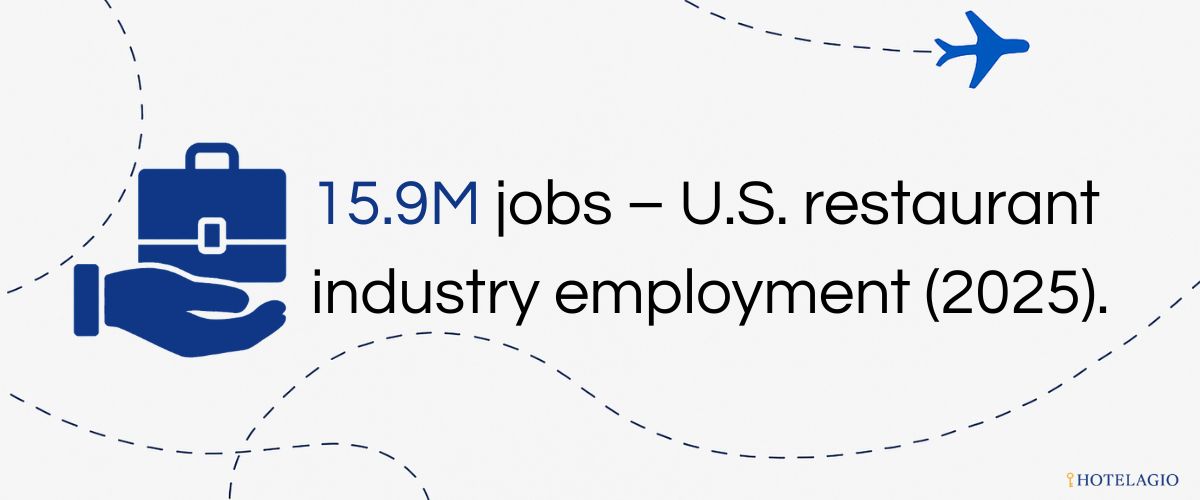
- The industry is expected to employ about 15.9 million people by end of 2025, making restaurants a major employer and essential part of the labor market.
- In recent months (Aug 2024–Aug 2025), eating and drinking place sales, adjusted for menu-price inflation, rose by roughly 2.5–2.9%, which marks a continuation of real growth despite economic headwinds.
- For chain restaurants in May 2025, same-store sales grew by about 1.4% year-over-year, while traffic trends showed mixed dynamics, indicating moderate growth but pressure on footfall.
- Roughly 47% of restaurants increased their menu prices in 2024, reflecting cost pressures and inflation passed on to customers.
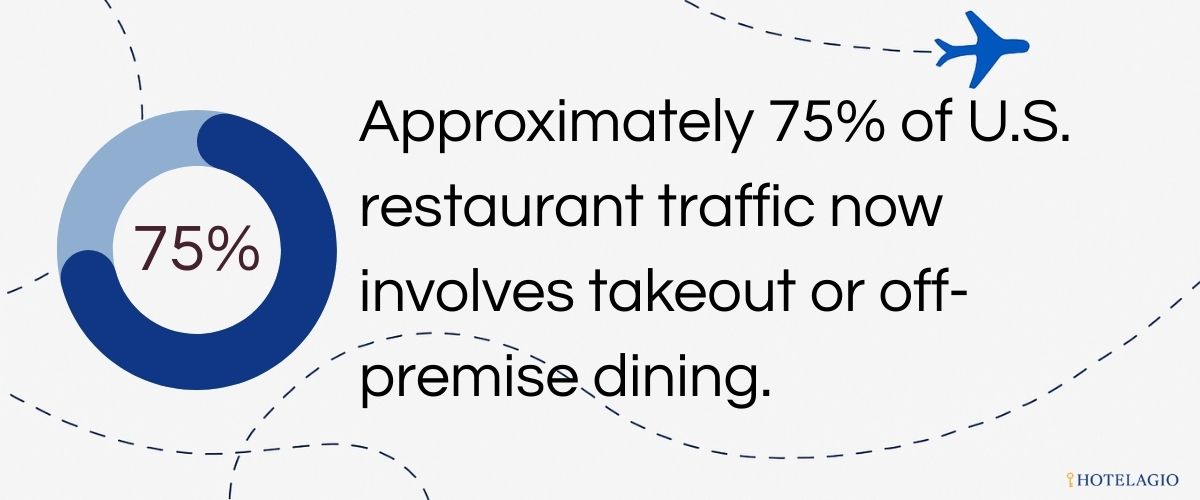
- A large portion of restaurant traffic is now driven by takeaway and off-premise consumption: according to one source, 75% of U.S. restaurant traffic involves takeout, a sign of how consumer habits shifted in recent years.
- The global food-service market (restaurants, delivery, catering etc.) is forecast to grow significantly, one estimate puts 2025 value at US $3.98 trillion, with long-term growth expected through 2030.
- Many restaurant operators remain cautiously optimistic: in a 2025 industry survey, about 41% of U.S. restaurants expect their 2025 sales to exceed 2024 levels, a modest but telling indicator of potential recovery.
How Large Is the Global Restaurant Industry?
The global restaurant and foodservice market continues its steady post-pandemic expansion.
Industry estimates indicate the total market reached approximately 3.6 trillion USD in 2024, with projections suggesting it may surpass 4 trillion USD by 2026.
Notable figures include:
- United States restaurant sales reached approximately 1 trillion USD in 2024.
- Europe’s foodservice market totaled around 630 billion USD.
- Asia-Pacific remains the fastest-growing region with annual growth rates between 6 and 9 percent.
- Quick-service restaurants (QSRs) accounted for roughly 45 percent of global foodservice sales.
Growth is driven by strong consumer demand, tourism recovery, lifestyle changes, and digital ordering expansion.
How Much Do Consumers Spend in Restaurants?
Consumer spending continues to rise despite inflationary pressures.
In 2024–2025, global restaurant spending increased by an estimated 8 percent year over year.
Key insights include:
- In the United States, average monthly per-household dining spend reached 356 USD.
- Delivery and takeout now represent 20 to 28 percent of total restaurant revenue, depending on region.
- Diners are willing to pay a premium for convenience: delivery fees increased by 5 to 12 percent across major platforms.
- Premium and experience-driven dining segments (fine dining, chef-driven concepts) saw some of the fastest revenue growth.
Spending behavior reflects a hybrid demand for convenience and high-quality experiential dining.
Which Countries Lead in Restaurant Industry Revenue?
A small number of markets generate a large share of global restaurant revenue.
The following table highlights 2024 estimates for the largest markets:
| Country | 2024 Revenue Estimate | Notes |
|---|---|---|
| United States | ~$1.0T | Largest global market |
| China | ~$830B | Rapid post-pandemic rebound |
| Japan | ~$260B | High dining-out frequency |
| United Kingdom | ~$90B | Growth in delivery & casual dining |
| Germany | ~$80B | Strong full-service market |
| India | ~$70B | Fast expansion in QSRs |
| South Korea | ~$60B | High spend per capita |
| Canada | ~$65B | Recovery driven by QSR expansion |
| Australia | ~$50B | Strong café culture |
| Brazil | ~$45B | Growing middle class |
Major markets with expanding middle-class populations, especially in Asia and Latin America, are projected to drive long-term growth.
What Are the Major Consumer Trends in the Restaurant Industry?
Restaurant demand is evolving quickly, with several clear behavioral trends shaping 2025.
The most significant include:
- Increased preference for convenience: more than 60 percent of consumers order delivery weekly.
- Rising demand for menu transparency, local sourcing, and sustainability certificates.
- Higher interest in plant-based menus; about 35 percent of consumers say they actively seek vegetarian or vegan options.
- Growth in health-conscious eating: low-sugar, low-sodium, and high-protein items outperform other menu categories.
- Experiential dining trends, such as chef collaborations, tasting menus, and immersive concepts.
- Ghost kitchens and virtual brands continue to expand in urban markets.
- Artificial intelligence adoption for menu engineering, demand forecasting, and customer personalization.
These shifts are influencing everything from pricing to staffing to kitchen operations.
What Are the Biggest Challenges Facing Restaurants Today?
Despite strong demand, restaurants face several structural challenges.
Key issues in 2024–2025 include:
- Labor shortages: more than 60 percent of operators report difficulty hiring and retaining staff.
- Rising food costs: ingredients such as beef, dairy, and imported goods have seen double-digit price increases.
- Higher occupancy and utility costs affecting profitability.
- Delivery platform fees reducing margins despite increased volume.
- Increased consumer price sensitivity in certain markets due to inflation.
- Regulatory pressures around sustainability, food safety, and worker protections.
These challenges continue to push restaurants toward innovation and operational optimization.
Restaurant Industry Technologies (2024/25 Snapshot)
Technology adoption has accelerated dramatically.
Key areas include:
- Digital ordering systems are used by more than 70 percent of full-service restaurants.
- Self-service kiosks increased in usage by 24 percent year over year.
- AI-powered demand forecasting and inventory management tools reduce food waste by up to 30 percent.
- Point-of-sale systems now integrate loyalty, delivery, and CRM functions.
- Robotics are increasingly used for repetitive tasks such as frying, coffee service, and cleaning.
Technology is now central to both customer experience and operational efficiency.
Hotel Restaurant Trends and Performance
High-end hotels, boutique properties, and luxury resorts increasingly use their restaurants as flagship experiences that attract not only guests but also local diners.
Key industry findings include:
- Hotel restaurants generated an estimated 210–250 billion USD globally in 2024, with steady growth projected through 2026.
- Approximately 55 percent of hotel guests dine at least once at the property’s restaurant during their stay.
- In luxury hotels, food and beverage operations often represent 35 to 50 percent of total revenue, outperforming room revenue in some urban markets.
- Hotels are among the fastest adopters of chef partnerships and branded dining concepts. Celebrity-led or chef-driven restaurants have become key tools for positioning and marketing.
- Breakfast remains the highest-volume meal service, but lunch and dinner revenues have increased due to improved menu design, upgraded service standards, and expanded beverage programs.
- Sustainability is a dominant trend: more than 60 percent of hotel restaurants now highlight local sourcing, waste-reduction initiatives, or climate-conscious menus.
- Technology continues to reshape operations, including digital ordering for room service, AI-driven menu engineering, and data-informed wine and beverage programs.
- Many hotels report strong performance from experiential dining concepts such as rooftop venues, tasting menus, and immersive culinary events aimed at both hotel guests and local residents.
Expert Insights
Hudson Riehle — Senior Vice President, Research, National Restaurant Association
“The restaurant industry is on track to exceed one trillion dollars in sales for the first time. Demand is strong, but operators continue to face significant labor and cost challenges.”
Danny Meyer — Restaurateur & Founder of Union Square Hospitality Group
“The dining experience today must deliver something that cannot be replicated at home. Hospitality, creativity, and personalization are more important than ever.”
Sarah Lockyer — Chief Brand Officer, Restaurant Business
“Digital convenience is no longer a differentiator. It is the baseline expectation across casual, quick service, and even fine dining.”
Euromonitor International Analyst
“Premiumization and convenience are the two dominant forces shaping the future of restaurants. Consumers are trading up and trading down, sometimes in the same week.”
FAQ – Restaurant Industry Insights
How large is the global restaurant industry?
The global foodservice market is estimated at around 3.6 trillion USD in 2024 and continues to grow annually.
Which country has the largest restaurant industry?
The United States leads with roughly 1 trillion USD in annual foodservice revenue.
Is the restaurant industry still growing?
Yes, most global markets show year-over-year growth, with Asia-Pacific leading expansion.
How often do consumers order restaurant delivery?
More than 60 percent of consumers order delivery at least once per week.
What is the biggest challenge for restaurants in 2026?
Labor shortages and rising costs remain the most cited difficulties among operators.
Sources
- National Restaurant Association — 2024–2025 State of the Restaurant Industry Reports
- Euromonitor International — Global foodservice market data and industry forecasts
- McKinsey & Company — Research on consumer behavior, delivery economics, and foodservice technology
- Statista — International restaurant market size and segment analysis
- IBISWorld — Industry metrics for foodservice segments worldwide

0 Comment