

Priceline is one of the most recognizable online travel agencies (OTAs) in the world and a flagship brand of Booking Holdings.
Known historically for its “Name Your Own Price” bidding model, today Priceline focuses on discounted hotel rates, bundled travel packages, rental cars, and partner-driven loyalty programs.
As global travel demand has rebounded, the Priceline brand has benefited from strong North American travel trends, increasing digital adoption, and continued consolidation in the OTA space.
This article compiles the most recent statistics available for Priceline and Booking Holdings to provide an up-to-date picture of traffic, revenue, user behavior, and the platform’s position in the online travel ecosystem.
Key Priceline Stats
- Priceline operates globally as part of Booking Holdings, a travel group serving customers in over 200 countries and territories.
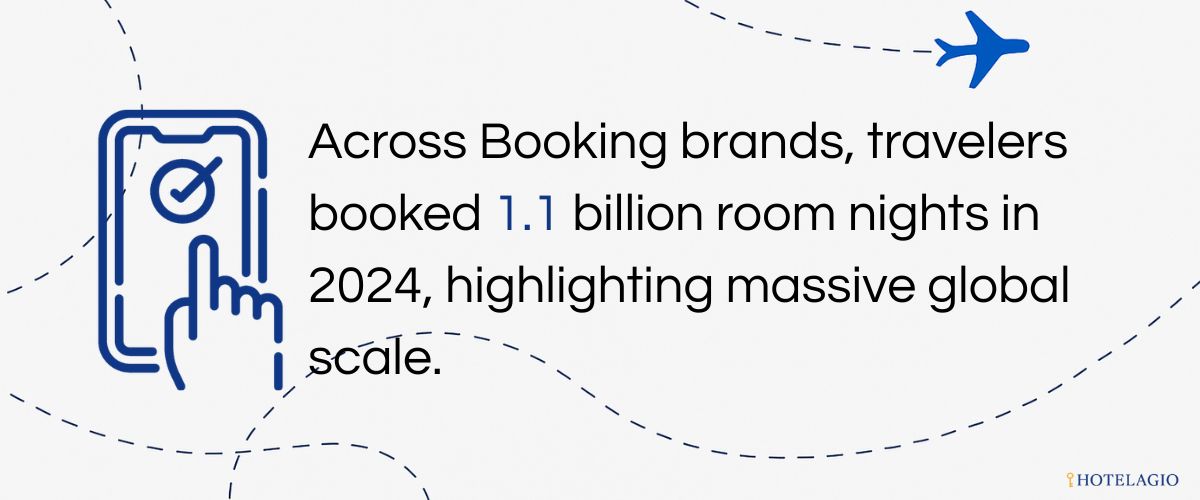
- Booking Holdings generated approximately $23.7 billion in total revenue in 2024, reflecting strong post-pandemic travel demand.
- The company reported $5.88 billion in net income in 2024, highlighting its position as one of the most profitable travel platforms worldwide.
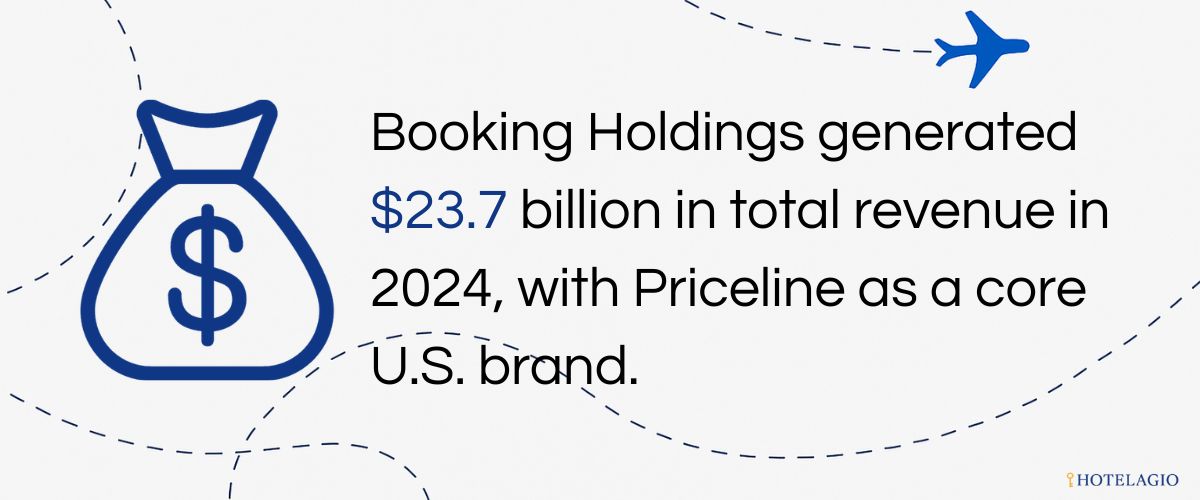
- Across Priceline and other Booking brands, users booked 1.1 billion room nights in 2024, showcasing the enormous scale of the ecosystem.
- Total gross travel bookings reached $166 billion in 2024, one of the highest figures in the online travel industry.
- Booking Holdings’ accommodation portfolio includes more than 31 million listings globally, spanning hotels, apartments, and alternative stays.
- The company employs over 24,000 people worldwide, supporting operations, customer service, product, tech, and partner relations.
- Priceline contributes to a group that dominates the global online travel market, competing closely with Expedia, Trip.com, and Airbnb.
- The brand remains especially strong in the U.S. market, where its hotel and flight bundles are among the most frequently promoted travel deals.
- Priceline’s inventory includes hundreds of thousands of hotels, along with flights, rental cars, cruises, and vacation packages, making it one of the most comprehensive online travel agencies.
How Many People Use Priceline Each Year?
Priceline does not publish standalone annual user counts, but aggregate OTA data and third-party analytics indicate significant scale.
Based on 2024–2025 estimates:
- Priceline attracts between 25 and 30 million monthly site visitors.
- Annual web visits exceed 300 million across desktop and mobile.
- A majority of Priceline’s audience is U.S.-based, with the brand remaining one of the most popular OTAs in North America.
As part of Booking Holdings, Priceline contributes to the group’s more than 1.1 billion room-nights booked in 2023 and continued growth in 2024.
How Much Revenue Does Priceline Generate?
Booking Holdings does not break out revenue by brand, but Priceline is part of a group generating record financial performance.
Booking Holdings:
- 2023 annual revenue: $21.4 billion (all-time high)
- 2024 revenue growth: projectable mid-single digits
- 2023 gross bookings: $150.6 billion across all brands
Priceline represents a meaningful share of Booking Holdings’ U.S. revenue, particularly in hotels and rental cars.
Priceline’s Market Position Among Online Travel Agencies
Priceline remains one of the top OTAs in the United States. While Booking.com dominates globally and Expedia remains strong in North America, Priceline continues to hold a solid mid-tier position thanks to discounted hotel pricing and vacation packages.
| OTA Brand (US Market) | Approx. 2024 Market Share | Notes |
|---|---|---|
| Booking.com (Booking Holdings) | ~34% | Global leader, large US growth |
| Expedia.com (Expedia Group) | ~30% | Strong US presence |
| Priceline (Booking Holdings) | ~10–12% | Price-sensitive travelers |
| Hotels.com (Expedia Group) | ~8% | Rewards program focus |
| Agoda (Booking Holdings) | ~4% | APAC strength, smaller US share |
| Others | Remaining share | Includes Hopper, Kayak, niche OTAs |
Priceline remains exceptionally competitive in discounted hotels and rental cars due to long-standing supplier relationships.
What Traffic Does Priceline Receive Each Month?
According to 2024 analytics:
- Total monthly visits: ~25–30 million
- Desktop vs mobile: ~65% mobile, ~35% desktop
- Average visit duration: 3–4 minutes
- Peak usage periods: summer travel (June–August) and holiday season (November–December)
Growth is driven by mobile app adoption and increased price-shopping behavior among travelers.
What Are Priceline’s Most Used Services?
Priceline’s revenue and search data show that users primarily convert on three product categories.
| Priceline Product | Usage Share (est.) | Notes |
|---|---|---|
| Hotels | ~60% | Primary revenue driver |
| Rental Cars | ~25% | Strong supplier network |
| Flights | ~10% | Competitive but lower-margin |
| Packages (Flight + Hotel) | ~5% | Used for value-driven travel |
Hotels and rental cars remain Priceline’s most profitable categories, while packaged travel grows slowly in a competitive market.
What Is Priceline’s Audience Demographic?
Available industry data indicates a strong skew toward U.S. and budget-conscious consumers.
Typical Priceline user:
- Age groups: 25–54 dominant
- Primary regions: United States, Canada, UK
- Travel spend behavior: value-driven, price-sensitive, frequent comparison shopping
- Higher conversion among mobile app users
Trends Shaping Priceline in 2024–2025
Several macro trends have influenced Priceline’s performance.
- Increase in domestic U.S. travel demand
Short-haul trips and road travel boosted hotel and rental car categories. - Price sensitivity among consumers
Inflation-driven shopping behavior increased Priceline’s appeal for discounted travel. - Growth in mobile bookings
More than 50% of Priceline bookings now occur on mobile devices. - Competitive pressure from Hopper and other mobile-native OTAs
Younger users increasingly experiment with alternative platforms. - Continued investment in loyalty partnerships
Priceline’s VIP Loyalty program aims at retaining high-frequency travelers.
s competitive advantage as a discount-oriented OTA within the larger Booking Holdings ecosystem.
Priceline Supply Model
Priceline partners with hundreds of thousands of hotels worldwide through Booking Holdings’ supplier network.
Key data:
- Access to over 2.6 million properties via Booking Holdings inventory
- Strong relationships with U.S. hotel chains and mid-range brands
- High availability in last-minute booking windows
- Competitive opaque pricing for value-conscious travelers
Priceline’s legacy “Express Deals” and “Pricebreakers” help it stand out in the discount accommodation segment.
FAQ – Priceline Platform Insights
How many people use Priceline?
Priceline receives around 25–30 million monthly visits, placing it among the major OTAs in the U.S.
Is Priceline owned by Booking.com?
Priceline is owned by Booking Holdings, which also owns Booking.com, Kayak, Agoda, and Rentalcars.com.
What is Priceline best known for?
Priceline is best known for discounted hotel rates, rental cars, and Express Deals, attracting value-focused travelers.
Does Priceline still offer “Name Your Own Price”?
No, the bidding feature was phased out; Express Deals replaced it with discounted, non-bid pricing.
Is Priceline safe to use?
Yes, Priceline is considered a reputable, large-scale OTA with secure payments and verified hotel partners.
Does Priceline have a loyalty program?
Yes, Priceline VIP Rewards offers tiered benefits including additional hotel discounts and savings on packages.
Sources
- Booking Holdings Annual Report — Financial performance, revenue, and gross bookings data
- SimilarWeb — Monthly traffic estimates for Priceline.com
- Phocuswright Research — OTA market share and North American travel behavior insights
- Statista OTA Market Data — OTA usage, demographics, and U.S. consumer trends
- Booking Holdings Investor Presentations — CEO and CFO commentary on market trends and demand resilience

0 Comment