


Kayak.com is one of the world’s most recognizable travel search engines, aggregating flights, hotels, rental cars, and vacation packages across hundreds of travel sites.
Founded in 2004 and acquired by Booking Holdings in 2013, Kayak has expanded into more than 60 international markets and continues to influence how travelers compare prices and plan trips.
As of 2025, Kayak remains a major player in global travel search, with growing user activity across mobile and metasearch channels.
Key KAYAK.com Stats
- In a recent month, KAYAK.com registered about 30.25 million visits, with an average session lasting roughly 6 minutes and 33 seconds.
- Desktop vs mobile: approximately 46.96% of visits come from desktops, and 53.04% from mobile devices — mobile now slightly dominates.
- The gender distribution among visitors is roughly 46.52% male and 53.48% female.
- The largest age group of KAYAK visitors are people aged 25–34, indicating a strong presence among younger-to-middle-age adults.
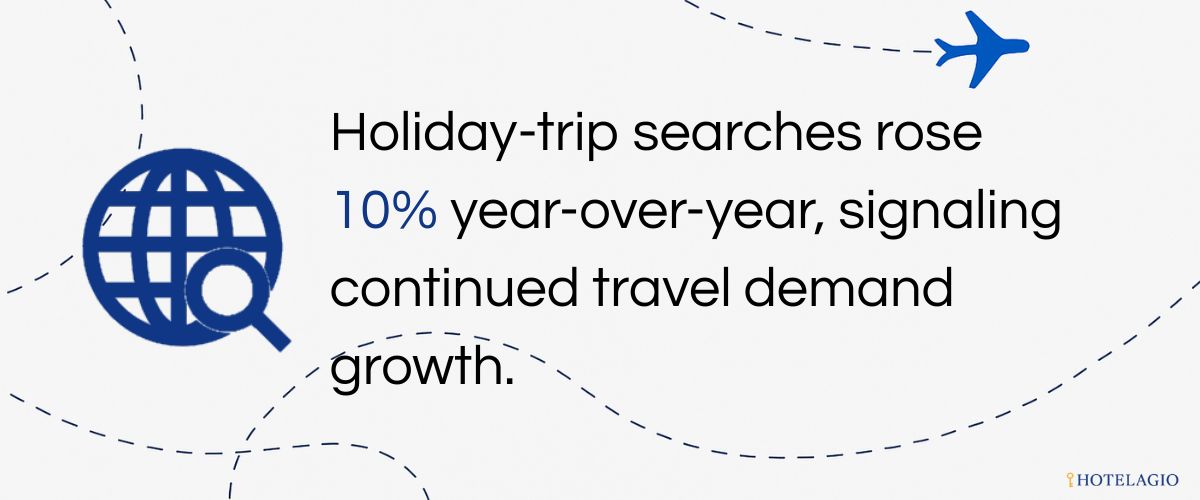
- Holiday/travel interest trend: According to KAYAK data, holiday-trip searches increased by 10% year-over-year in 2025 compared to 2024.
- For that same period, KAYAK reports that international flight prices dropped about 7% YoY.
- KAYAK offers services in roughly 20 languages across 30 countries, making it a truly global travel-search engine.
- The site aggregates searches for flights, hotels, rental cars and vacation packages — functioning as a comprehensive “one-stop” meta-search engine for travel.
How Many Users Does Kayak Have Each Year?
Kayak receives hundreds of millions of visits per year, driven primarily by flight search.
- In 2023, Kayak recorded approximately 800 million total visits across its global network.
- Monthly traffic fluctuates between 60 and 75 million visits depending on travel seasonality.
- Mobile searches now account for more than 55 percent of all user sessions.
Kayak’s strong brand recognition and global footprint continue to support its large user base.
How Much Revenue Does Kayak Generate?
Kayak does not publish standalone financial data because it is part of Booking Holdings, but the parent company reports:
- Booking Holdings generated over $21 billion in revenue in 2023.
- A significant portion comes from performance marketing and metasearch brands, including Kayak.
- Industry analysts estimate Kayak’s annual revenue contribution at roughly $400–600 million, largely from advertising, referral fees, and partnerships.
Kayak’s business model relies heavily on cost-per-click and cost-per-acquisition from airlines, hotel chains, OTAs, and rental car companies.
Which Countries Use Kayak the Most?
Kayak’s largest markets are the United States and Europe, with strong penetration in English-speaking and Western European countries.
| Country | Estimated Share of Global Traffic | Notes |
|---|---|---|
| United States | ~30% | Strongest market; home base |
| Germany | ~10% | One of the highest European user volumes |
| United Kingdom | ~8% | High flight search activity |
| France | ~6% | Steady year-round use |
| Spain | ~5% | Strong during summer season |
| Canada | ~4% | High cross-border search traffic |
| Brazil | ~4% | Largest South American market |
| Italy | ~3% | Popular for domestic and EU travel |
| Australia | ~3% | Frequent long-haul searches |
| Other markets | ~27% | Kayak operates in 60+ countries |
Language- and market-specific versions of Kayak help expand its global reach.
What Are the Most Popular Travel Searches on Kayak?
Search data from global reports and industry analyses consistently show:
| Category | Notes |
|---|---|
| Flights | Most-used product; dominates traffic |
| Hotels | Major revenue driver through referrals |
| Vacation rentals | Growing segment after 2021 |
| Rental cars | Strong in North America and Europe |
| Vacation packages | Smaller share but increasing |
| Kayak Explore | Popular tool for flexible-budget travelers |
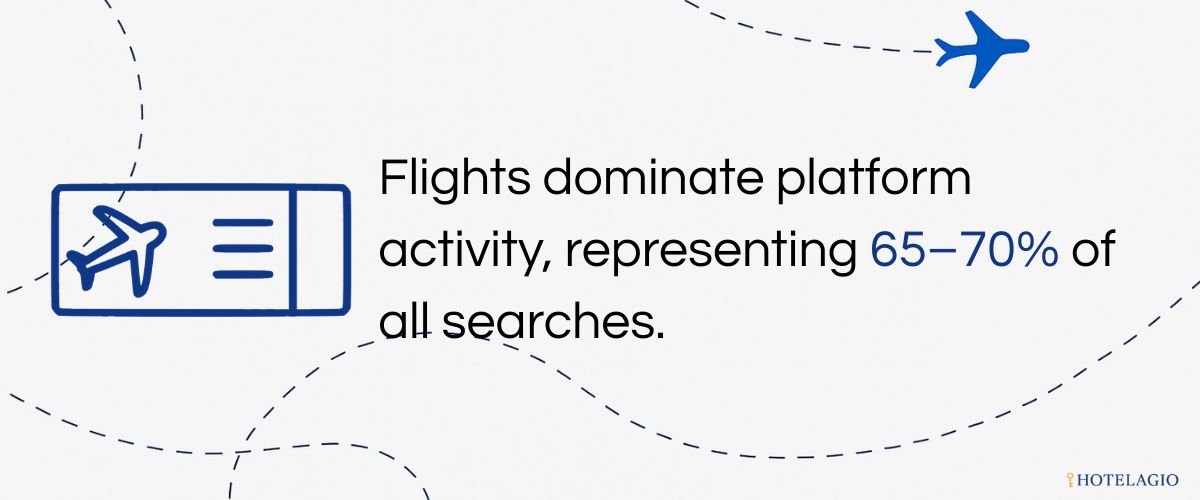
Flight search remains Kayak’s core strength, accounting for an estimated 65–70 percent of all platform activity.
Hotels Snapshot for Kayak Users
Travelers using Kayak show distinct patterns in hotel search behavior.
- Most-clicked hotel star categories: 3-star and 4-star hotels.
- Average price filters applied: $100–$200 per night.
- Mobile users convert at a higher rate on same-day and next-day bookings.
- Kayak’s hotel search sources inventory from Booking.com, Agoda, and dozens of independent suppliers.
The hotel segment remains one of Kayak’s most commercially important categories due to high referral revenue.
Key Trends, Technology, and Platform Developments
Several factors are shaping Kayak’s growth and strategy:
- Increased mobile adoption: over half of users search via smartphone.
- Expansion of Kayak-powered brand sites, including airline white-label search tools.
- Growth of metasearch competition from Google Flights and Skyscanner.
- Rising importance of AI-driven fare predictions and price alerts.
- Higher user interest in flexible travel tools like Kayak Explore and price tracking.
Kayak continues to focus on real-time travel data insights and simplifying comparison shopping.
FAQ – Kayak.com Insights
How many users does Kayak have each year?
Kayak receives roughly 800 million annual visits across its global platforms.
Is Kayak owned by Booking.com?
Yes. Kayak is owned by Booking Holdings, which also owns Booking.com, Priceline, Agoda, and OpenTable.
What is Kayak’s biggest market?
The United States is Kayak’s largest user base, followed by Germany and the United Kingdom.
How does Kayak make money?
Kayak earns revenue through advertising, referral fees, metasearch partnerships, and airline/OTA cost-per-click agreements.
Does Kayak show the cheapest prices?
Kayak aggregates prices from many suppliers but does not set prices. It reflects what partners provide in real time.
Is Kayak growing or declining?
Kayak’s traffic has remained stable, with growth in mobile and international markets but increased competition from Google Flights.
Sources
- Similarweb — Kayak.com traffic and engagement statistics
- Booking Holdings Annual Report — Financial disclosures for Kayak’s parent company (revenue, business overview)
- Statista — Global market data on Kayak usage
- Skift Research — Industry analysis on metasearch and travel search trends
- Official Booking Holdings Statements — Executive commentary and technology statements

0 Comment