


The Grand Canyon is one of the most iconic natural wonders on Earth—its colossal scale, geological layers and dramatic vistas draw adventurers and tourists alike.
In 2024, the park recorded ~4,919,163 visits, making it among the top-visited national parks in the United States.
Beyond sheer numbers, the Grand Canyon plays a pivotal role in the regional economy of northern Arizona and in America’s outdoor-tourism identity.
Key stats: Grand Canyon Tourism
- ~4.92 million visits in 2024 — the Grand Canyon continues to draw millions of visitors annually.
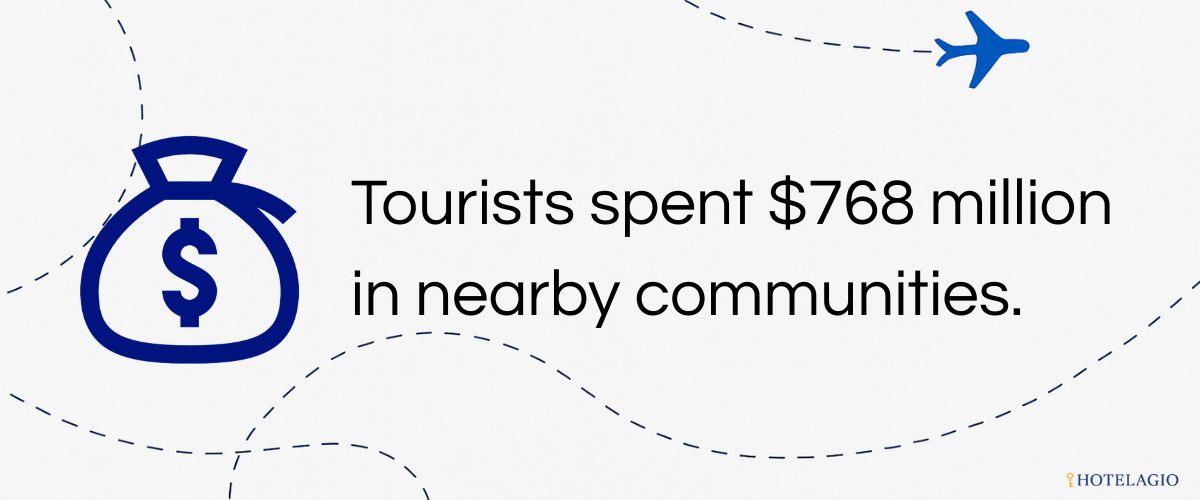
- Visitors in 2023 spent $768 million in nearby communities — a strong economic contribution regionally.
- That spending supported around 10,100 local jobs and injected $1 billion into the regional economy.
- The park is among the top-visited national parks in the U.S. — a major tourism destination.
- Across all U.S. national parks, there were 331.9 million recreation visits in 2024, contextualising GCNP’s share of the overall national-park tourism market.
How Many Tourists Visit the Grand Canyon Each Year?
In 2024, the park recorded ~4.919 million visits.
- 2023: ~4.734 million visits.
- 2022: ~4.732 million visits.
- Pre-pandemic (2019): ~6–6.2 million visits.
The Grand Canyon remains consistently among the top U.S. national parks by visitation.
How Many Tourists Visit the Grand Canyon Each Day?
With ~4.919 million annual visits in 2024, the average works out to roughly 13,460 visits per day.
However, peak months (June–July) see many more visitors daily—often tens of thousands—while shoulder- and off-season months are significantly less crowded.
How Much Do Visitors Spend at the Grand Canyon Region?
While exact up-to-date total spending for the Grand Canyon region was not publicly detailed in the most recent dataset, past figures show strong economic impact. For example:
- In 2022, ~4.73 million visitors supported approximately $759 million in spending in the region.
- The park’s role is growing as part of the broader U.S. national park visitation record (331.9 million visits for all park units in 2024).
Interpretation: High visitation combined with lodging, tours, concessions and related operations make the Grand Canyon a major economic engine for northern Arizona.
Which Countries & Regions Bring Visitors?
While most visitors are domestic U.S. travelers, international tourism plays a role. Specific national-origin breakdowns for 2024 weren’t easily found in public summary data. However:
- The vast majority of visits (≈ 90%) occur at the South Rim, which is accessible year-round and hosts most visitor facilities.
- The North Rim is more remote, seasonal and receives far fewer visitors.
- Typical U.S. source states include California, Arizona, Texas, New York, Florida (older survey data)
Recommendation: For deeper detail, consult recent National Park Service (NPS) visitor-use reports or regional tourism offices.
What Are the Most Visited Areas & Attractions Within the Grand Canyon?
While there isn’t a public ranking of every attraction’s visitor number, these key zones and features draw the most attention:
| Area | Notes |
|---|---|
| South Rim Viewpoints (Mather Point, Yavapai, Grandview) | Most accessible viewpoint network; majority of visitors |
| Bright Angel Trail & Rim Trail | Popular short and long hikes |
| Skywalk at Grand Canyon West (outside the park) | Visited as day-trip extension |
| Colorado River Rafting & Inner Gorge | Adventure tourism segment |
| North Rim (open mid-May to mid-Oct) | Less visited, wilderness experience |
| Helicopter/air tours | Premium visitor experience |
When Is the Best Time to Visit the Grand Canyon?
Visitation and visitor experience vary significantly by season:
| Season | Trend | Notes |
|---|---|---|
| Winter (Dec–Feb) | Lower crowds, cooler weather | South Rim open; North Rim closed |
| Spring (Mar–May) | Rising visitation | Pleasant weather |
| Summer (Jun–Aug) | Peak visitation | Very crowded, hot temperatures |
| Autumn (Sep–Nov) | Moderate-high visitation | Often good weather, fewer summer crowds |
For quieter experience and cooler temperatures: March–May and September–October are ideal.
What Are the Biggest Events & Trends Affecting the Grand Canyon?
While the park doesn’t host large commercial festivals like some destinations, important trends and special events include:
- Centennial and anniversary programming (e.g., 2019 was 100th anniversary of park establishment)
- Infrastructure upgrades at rim facilities and visitor centers
- Growing popularity of adventure-tourism segments (rafting, back-country, helicopter tours)
- Ecological and management challenges (wildfire risk, visitor-capacity management, remote-area closures)
Example: Wildfire impacts on the North Rim in 2025 have required partial closures.
These trends affect access, visitor experience and long-term sustainability.
How Much Does the Grand Canyon Contribute Economically?
Although specific 2024 or 2025 economic data were not prominent in publicly summarized sources, visitation of ~4.9 million combined with regional spending estimates of hundreds of millions indicate major economic significance. Past data: ~4.73M visitors (2022) generated ~$759 million in regional spending.
The park also supports local infrastructure, lodging, transport businesses and helps drive tourism to adjacent areas (Flagstaff, Williams, Page).

How Busy Are Lodging & Visitor Services?
Visitor services and accommodations on the South Rim, in nearby gateway towns and within the park are heavily utilized, especially during peak months.
Important points:
- Reservations for popular side-trails, back-country permits and lodging fill quickly.
- North Rim is seasonally open (mid-May to mid-Oct) and fewer accommodations available / fewer visitors than South Rim.
- Summer months (June–July) see the highest volume; off-season months (Dec–Feb) provide more availability and lower rates.
Which Parts of the Grand Canyon Park Are Best to Stay Near or Visit?
Main visitor hubs and considerations:
- South Rim (Arizona, near Grand Canyon Village): Most visitor facilities, museums, viewpoints, shuttle services – best for first-time visitors.
- North Rim (Arizona, Kaibab Plateau): Higher elevation, quieter, open seasonally — ideal if you prefer fewer crowds but accessible only May-October.
- East Entrance / Desert View: Panorama views along the South Rim away from the main Village crowds.
- West Rim / Grand Canyon West: Commercial tribal-run area, including skywalk, typically visited as day trips from Las Vegas but not part of the national park unit.
- Gateway towns: Williams, Flagstaff, Page offer lodging, tours, and extensions (Antelope Canyon, Lake Powell, etc.).
FAQ – Grand Canyon Tourism Insights
How many visitors does the Grand Canyon receive yearly?
About 4.919 million visits in 2024.
Which rim is most visited?
The South Rim, accounting for roughly 90% of the park’s visitation.
When is the best time to visit to avoid crowds?
Late September–October or March–April offer fewer crowds with good weather.
Are there major costs to visit the park?
Entrance fee: typically $35 per vehicle, valid for 7 consecutive days (rates may vary).
How accessible is the North Rim?
It is open roughly mid-May to mid-October, weather-dependent, and offers fewer visitor services.
Can you see Colorado River rafting or helicopter tours?
Yes — rafting, helicopter/air tours and back-country adventures are part of the visitor mix, though usually booked in advance.
Sources
- National Park Service (NPS) — Grand Canyon National Park Statistics: 2024 Visitation
- Smithsonian Magazine — These Were the Most—and Least—Visited National Parks in 2024 (Grand Canyon ranked ~4.919M)
- Road Genius — Grand Canyon Tourism Statistics – Visitor Spend & Jobs (2022 baseline)
- National Park Visitor Use Dashboard — Visitor Use Data – NPS recreation visits 2024
- Outside Online — National Park Visitation Hit an All-Time High in 2024 (context for Grand Canyon)

0 Comment