


The golf industry has entered a period of renewed global growth driven by rising participation, increasing investment in facilities, and strong consumer spending.
Golf is now played by more than 119 million people worldwide, whether on a course, at driving ranges, or digitally through simulators.
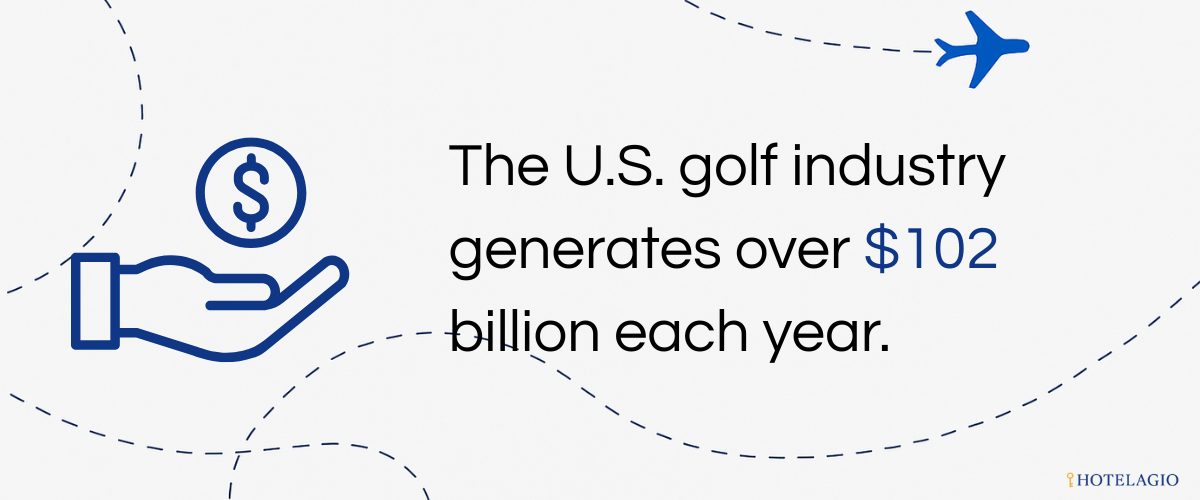
In the United States alone, golf generated over $102 billion in economic activity, while worldwide the sport supports millions of jobs and continues to expand into new regions.
Key Golf Industry Stats
- The global golf industry is valued at roughly 300 billion dollars, making it one of the largest recreational sports markets in the world.
- More than 119 million people worldwide engage with golf, either by playing, watching or following the sport in media.
- In the United States alone, over 25 million golfers hit the course each year, which is nearly one in ten Americans.
- Participation among young adults is rising, with players aged 18 to 34 now making up about 28 percent of all golfers.
- Women’s golf continues to grow, with female players accounting for about 25 percent of all new participants.
- The number of on-course rounds played in the US recently topped 530 million annually, driven in part by renewed interest after the pandemic.
- Off-course golf venues, including simulators and entertainment ranges, now attract more than 40 million players, making this segment larger than traditional on-course play for the first time.
- Golf tourism contributes over 20 billion dollars globally each year as travelers book destination courses, resorts and tournaments.
- The industry supports roughly 1.6 million jobs in the United States, ranging from course maintenance to hospitality and equipment manufacturing.
- Spending on golf equipment remains strong, with US annual sales exceeding 6 billion dollars, boosted by demand for premium clubs and technology-enhanced gear.
- The rise of indoor golf simulators continues, with the market expected to surpass 3.4 billion dollars within the next few years as more players practice year-round.
- Environmental initiatives are gaining traction, and more than 40 percent of courses now report active sustainability programs focused on water use, turf management and biodiversity.

How Many People Play Golf Worldwide?
Golf participation has grown significantly in recent years, driven largely by younger players, women, and newcomers who enter the sport through off-course experiences.
Key figures include:
- An estimated 119 million people globally engage with golf (on-course, driving ranges, and entertainment golf).
- 34 million golfers actively play on a course, with strong growth in Asia-Pacific and Europe.
- In the United States, participation has reached over 41 million, including both on-course and off-course activities.
- Off-course golf (simulators, Topgolf-style venues) continues to outpace traditional growth, increasing accessibility for new demographics.
Global demand reflects a shift toward more informal, flexible, and technology-enhanced formats.
What Is the Economic Impact of the Golf Industry?
Golf is one of the largest sports industries in the world, generating significant economic activity across tourism, real estate, retail, and hospitality.
Recent financial metrics:
- The global golf market is valued at approximately $75 to $85 billion annually.
- In the United States, the golf industry contributes over $102 billion to the economy each year.
- Golf tourism accounts for about $25 billion globally, with destinations like Scotland, Florida, Spain, and South Africa leading demand.
- Equipment sales reached more than $8.5 billion worldwide in 2024.
- Golf course maintenance and sustainability improvements represent a growing operational expenditure category.
The industry benefits from both traditional spending and rapid expansion into entertainment-driven formats.
Which Countries Have the Most Golf Courses?
Golf remains concentrated in a handful of countries, though new markets in Asia and the Middle East continue to grow.
| Country | Number of Courses | Notes |
|---|---|---|
| United States | ~16,000 | Largest golf market in the world |
| Japan | ~3,000 | Strong post-pandemic resurgence |
| Canada | ~2,300 | High per-capita participation |
| England | ~1,900 | Largest in Europe |
| Australia | ~1,500 | Major regional hub |
| Germany | ~750 | Steady growth |
| South Korea | ~600 | High simulator usage |
| France | ~600 | Increasing youth participation |
| Spain | ~500 | Driven by golf tourism |
| South Africa | ~450 | Leading African golf nation |
These countries form the core of global golf infrastructure and participation.
Which Markets Drive the Most Golf Tourism?
Golf tourism is one of the most lucrative segments of sports travel.
Top destinations for golf travelers include:
- Scotland
- United States (Florida, Arizona, California, South Carolina)
- Spain (Costa del Sol, Balearic Islands, Catalonia)
- Portugal (Algarve)
- UAE (Dubai, Abu Dhabi)
- South Africa
- Thailand and Vietnam
Golf tourists typically spend 120 to 200 percent more than average leisure travelers, making them highly valuable for destinations.
What Are the Most Important Trends Shaping the Golf Industry?
Several emerging trends define the direction of the golf market in 2025.
- Growth of entertainment golf venues, now representing more than 25 percent of all golf engagement in the U.S.
- A major rise in golf simulators, with the simulator market valued at over $1.6 billion and growing at double-digit rates.
- Increased focus on sustainability, water conservation, and environmentally responsible turf management.
- Strong demand for shorter, more flexible formats, including 9-hole play and practice-only visits.
- Significant participation growth among women and juniors, with youth golf programs expanding globally.
- Digital adoption through shot-tracking apps, GPS tools, and virtual coaching.
These trends reflect golf’s transition toward accessibility, technology, and environmental responsibility.
How Are Golf Courses Adopting Sustainability?
Sustainability has become a core strategic priority for golf facilities.
Key developments include:
- More than 50 percent of golf courses report adopting water conservation practices, including drought-resistant turf.
- Approximately 700 courses globally hold GEO certification for environmental stewardship.
- Solar-powered operations and electric maintenance equipment are increasingly common.
- Courses in drought-prone regions (California, Australia, Spain) are investing heavily in reclaimed-water systems.
- Biodiversity conservation projects are expanding, including native species planting and pollinator habitats.
Golf is increasingly aligning with sustainability standards demanded by players, governments, and communities.
Golf Industry Snapshot (Facilities, Players, Revenue)
Updated 2024–2025 estimates show:
- Over 38,000 golf facilities worldwide.
- Approximately 300,000 full-time industry jobs in the United States alone.
- Youth golfers represent over 3.5 million participants in the U.S. market.
- Women now account for 25 to 28 percent of new player growth.
- Entertainment venues receive more than 35 million annual visits globally.
The industry is expanding at both traditional and alternative touchpoints.
How Big Is the Global Golf Resort Market?
Golf resorts represent one of the most profitable and influential segments of the global golf industry. Combining lodging, leisure, spa services, dining, and golf experiences, they attract high-spending travelers and play a major role in tourism-driven economies.
Key global statistics include:
- The global golf resort market is valued at approximately $22–28 billion, with steady annual growth rates between 4 and 6 percent.
- Golf resort guests typically spend 2.5 to 4 times more per trip than average leisure travelers.
- Occupancy rates at major golf resorts (U.S., Europe, Middle East, and Asia-Pacific) averaged 67–75 percent in 2024, with peak-season occupancy exceeding 85 percent in top destinations.
- The average length of stay at golf resorts ranges from 3.5 to 5.2 nights, depending on region and resort class.
- More than 60 percent of golf travelers choose destinations specifically because of on-site resort facilities rather than golf alone.
- Premium and luxury golf resorts account for close to 40 percent of total global golf resort revenue, driven by demand for spa services, wellness programs, and fine dining.
- Multi-course golf resorts (properties with 36 holes or more) report the highest visitor satisfaction and return rates.
Leading Regions for Golf Resorts
Golf resorts are concentrated in a few global clusters known for year-round playability and tourism infrastructure.
| Region | Key Destinations | Notes |
|---|---|---|
| United States | Florida, Arizona, California, Hawaii, South Carolina | Largest market for golf resorts |
| Europe | Spain, Portugal, Scotland, Ireland, Turkey | Strong tourism base; golf holiday hubs |
| Middle East | UAE (Dubai, Abu Dhabi) | Rapid expansion and premium positioning |
| Asia-Pacific | Thailand, Vietnam, Japan, Australia | Fastest-growing newcomer markets |
| Africa | South Africa, Morocco, Mauritius | High-end resort offerings |
These regions combine favorable climate, infrastructure, and international accessibility.
Sustainability and Golf Resorts
Sustainability has become a core differentiator among top resort properties.
- Over 45 percent of newly developed golf resorts incorporate renewable energy sources.
- Leading U.S. and European golf resorts report 20 to 30 percent reductions in water use through modern irrigation systems.
- Wildlife management and biodiversity protection programs are now common across GEO-certified resorts.
- Customer surveys show that 55 percent of golf travelers are more likely to book a resort with visible sustainability initiatives.
Expert Insights
Jay Karen — CEO, National Golf Course Owners Association
“Golf continues to evolve, with new participation formats leading the way. Entertainment golf and technology-driven experiences are bringing unprecedented numbers of people into the game.”
Mike Whan — CEO, USGA
“The future of golf depends on accessibility, sustainability, and innovation. Our responsibility is to ensure that the game grows without compromising environmental or community needs.”
Steve Mona — Former CEO, World Golf Foundation
“Golf’s economic impact remains immense. Tourism, real estate, and recreation form a powerful combination that supports jobs and regional development.”
Rory McIlroy — Professional Golfer & Investor
“Technology is changing the way people enter the sport. Simulators, analytics, and entertainment venues are lowering the barrier to entry in ways we’ve never seen before.”
FAQ – Golf Industry Insights
How many people play golf worldwide?
Approximately 119 million people engage with golf worldwide across on-course and off-course formats.
How large is the golf industry economically?
The global golf market is valued between $75 and $85 billion annually, while the U.S. alone generates over $102 billion.
Which countries have the most golf courses?
The United States leads with about 16,000 courses, followed by Japan, Canada, and England.
Why is golf tourism significant?
Golf tourists spend more than typical leisure travelers, generating around $25 billion globally.
How is sustainability influencing the golf industry?
Courses are adopting water-saving technologies, renewable energy, biodiversity programs, and environmental certifications.
Sources
- National Golf Foundation (NGF) — Annual golf participation and industry economic impact reports
- R&A Global Golf Participation Report — Worldwide golf participation statistics
- PGA of America — Golf tourism data and industry trends
- Sustainable Golf / GEO Foundation — Environmental certification data and sustainability practices
- Sports & Leisure Market Research — Golf equipment sales, simulator market, and industry growth metrics

0 Comment