

The creator economy is no longer niche.
Analysts size the market at about $205 billion in 2024, with forecasts topping $1.3 trillion by 2033.
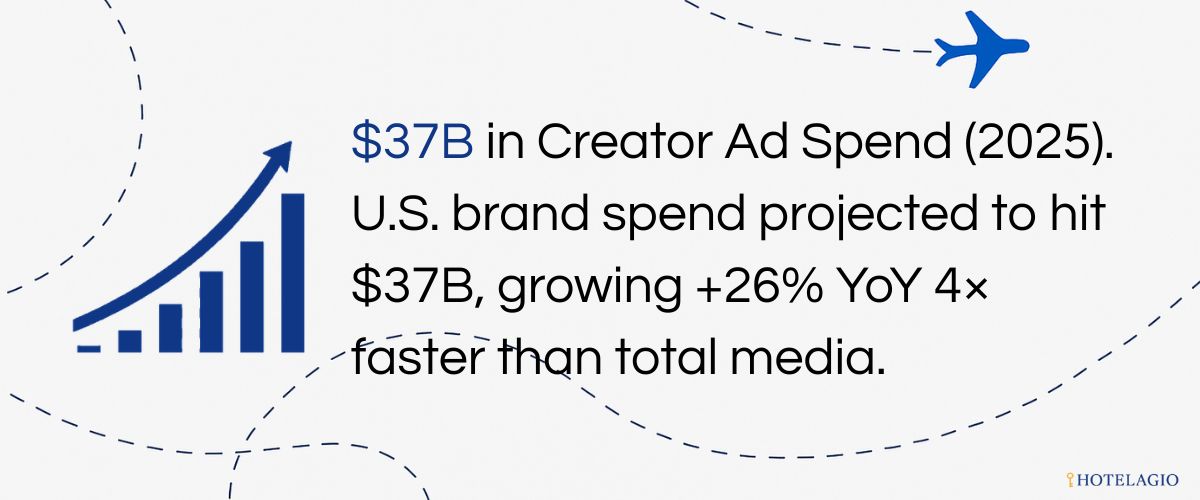
Meanwhile, advertisers are shifting budgets quickly: creator ad spend is projected to hit $37 billion in 2025, up 26% year over year—about 4x faster than overall media growth.
And the platforms are paying: YouTube says it has paid over $70 billion to creators in the past three years.
Key Creator Economy Stats
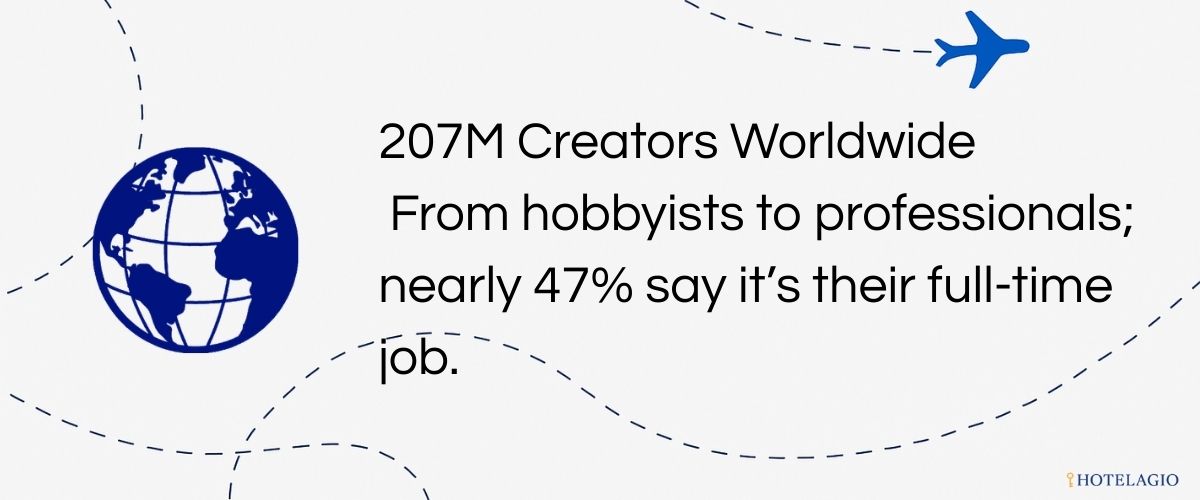
- There are roughly 207 million content creators worldwide, spanning hobbyists, part-timers, and professionals.
- Market size: $205.25B (2024); forecast $1.346T by 2033 at 23.3% CAGR.
- Forecasts suggest the market may grow to US$ 528 billion by 2030, under a compound annual growth rate (CAGR) of ~22–23%.
- In 2025, ad spend targeting the creator economy is projected to reach US$ 37 billion, growing roughly 4× faster than the total media industry.
- Nearly 47% of creators consider content creation their full-time job.
- However — only a small fraction (≈ 4%) of creators globally earn more than US$ 100,000 per year.
- Many creators start slowly: on average it takes about 6.5 months to earn their first dollar from content creation.
- Despite the large creator population, only around 2–4% of creators reach follower counts that typically generate high income (e.g. 100,000+ followers).
- Among individual creators, nearly 60% of the industry’s revenue comes from solo content creators (as opposed to corporations or large media companies).
- Platform payouts: YouTube paid $70B+ to creators in the last 3 years. Patreon crossed $10B all-time creator payments (2025).
- Substack scale: 5M+ paid subscriptions by March 2025.
- LTK commerce: creators on LTK drive $5B+ in annual retail sales; lifetime payouts exceed $2.5B.
- Workforce: full-time digital creator jobs in the U.S. rose from 200k (2020) to 1.5M (2024).
- Tools: 86% of creators report using generative AI in their workflows.
How big is the market, and where is growth coming from?
Most recent market models cluster around a $200B+ base in 2024, with double-digit growth driven by brand deals, affiliate commerce, fan payments, and platform revenue shares. Grand View Research projects 23%+ CAGR through 2033 (to $1.346T), reflecting more direct-to-fan monetization and new ad formats around short video and live streaming.
On the demand side, brands are moving spend quickly. IAB’s late-2025 outlook puts creator ad spend at $37B in 2025, up 26% year over year and outpacing total media growth by a wide margin.
Which platforms are paying, and how much?
Platform disclosures and reputable reporting give a concrete baseline for money flowing to creators.
Platform payout snapshot
| Platform | Latest verifiable payout scale | Notes |
|---|---|---|
| YouTube | $70B+ paid to creators in the last 3 years | Official Creators page statement. |
| Patreon | $10B+ lifetime to creators (as of Aug 2025) | CEO confirmation. |
| Substack | 5M+ paid subscriptions (by Mar 2025) | Company figures via FT/Wikipedia. |
| LTK | $5B+ annual retail sales driven; $2.5B+ paid to creators (lifetime) | Company releases and recent interview. |
How many creators are there?
Headcounts vary by definition (posting vs. monetizing vs. full-time). Adobe’s widely cited estimate put the global creator population at ~303 million in 2022; multiple 2024–2025 roundups put the figure in the 200–300 million range. Full-time creators are a subset, but the broader workforce around creators is expanding: U.S. full-time digital creator jobs are estimated to have grown 7.5x since 2020 (to 1.5M in 2024).
How is the money distributed?
Earnings are highly concentrated. Academic analysis of creator earnings across platforms finds power-law patterns—meaning a small minority capture a large share of income. Market reports echo this: even as total payouts rise, a majority of creators still earn modestly, with brand deals and affiliate commerce often out-earning platform rev-shares for mid-tier creators.
What are the creator income engines?
Three clusters dominate:
- Brand dollars: the fastest-growing pot, projected $37B in 2025 in the U.S. alone.
- Platform revenue shares: YouTube’s multi-format payouts lead the pack on scale.
- Direct-to-fan: subscriptions, memberships, and paid newsletters—Patreon’s $10B lifetime payouts and Substack’s 5M+ paid subs show product-market fit.
Commerce-driven affiliate ecosystems like LTK—which report $5B+ in annual retail sales—round out the mix and increasingly blend with brand budgets.
What about AI, does it change the math?
Short answer: AI is now standard tooling. A 2025 Adobe survey reports 86% of creators use generative AI, mostly for editing, asset generation, and ideation. This speeds output and reduces costs, but also raises concerns over training data, attribution, and platform policy changes.
At-a-glance tables
Market and spend
| Metric | Latest figure |
|---|---|
| Creator economy size (2024) | $205.25B |
| 2033 forecast | $1.346T |
| 2025 creator ad spend (U.S.) | $37B |
Platform signals
| Item | Latest figure |
|---|---|
| YouTube creator payouts (3 yrs) | $70B+ |
| Patreon lifetime payouts | $10B+ |
| Substack paid subs | 5M+ |
| LTK retail sales via creators | $5B+ / year |
Workforce and tools
| Item | Latest figure |
|---|---|
| U.S. full-time digital creator jobs (2024) | 1.5M |
| Creators using gen-AI | 86% |
How big is the travel niche, and where does the audience come from?
Travel creators operate at the intersection of inspiration and direct commerce.
On TikTok, travel content remains a massive discovery engine: recent roundups estimate #travel at 125+ billion views and show travel hashtags growing sharply in 2023–2025.
On YouTube, travel video remains a top planning resource, Google’s latest market work in India found 68% of travelers use YouTube for trip inspiration, one signal of YouTube’s global role in the research phase.
Pinterest’s 2025 trends also point to elevated demand for outdoors and mountain trips, reinforcing that travel intent is strong across visual platforms.
Social content doesn’t just inspire, it converts.
Phocuswright reports that two in three travelers under 55 booked based on social media content they viewed for a recent trip. Skift’s 2025 coverage similarly confirms social’s growing role in planning and booking.
Which platforms are best for travel creators today?
- TikTok for top-of-funnel discovery and short-form inspiration; creators tap trending travel hashtags and the Creative Center to catch waves early.
- YouTube for mid- to bottom-funnel research, long-form guides and itinerary videos that drive bookings; fresh survey data shows material use of YouTube in planning.
- Pinterest for intent signaling (boards, “Predicts” categories like peak-travel/mountains), useful for seasonality and product tie-ins.
- OTAs and travel brands for last-mile conversion programs purpose-built for creators, like Expedia’s Travel Creator Program.
FAQ
How big is the creator economy today?
Most recent models put 2024 at ~$205 billion, with long-range forecasts above $1 trillion by the early 2030s.
Is brand spend still growing?
Yes. The IAB projects $37B in creator ad spend for 2025, up 26% from 2024, well ahead of total media.
Which platforms are most profitable for creators overall?
YouTube leads on pure payout scale ($70B+ in three years). Direct membership models (Patreon, Substack) and commerce platforms (LTK) add significant, diversified income streams.
How many creators are there?
Depending on definition, 200–300 million globally. U.S. full-time creator jobs are estimated at 1.5 million in 2024.
Is AI actually used by creators?
Yes. 86% say they use generative AI for editing, asset generation, or ideation.
Sources
- Grand View Research — Creator Economy Market Size, Share & Trends
- IAB — Creator Economy & Advertiser Outlook
- YouTube Creators — YouTube Partner Program: Creator Payouts
- Axios — Patreon surpasses $10B in total creator payments
- Financial Times / Wikipedia — Substack passes 5M paid subscriptions (company figures)
- LTK — LTK Creator Commerce: Annual Retail Sales & Payouts
- Axios — Full-time U.S. creator jobs reach 1.5M
- TechRadar Pro — Adobe 2025 survey: 86% of creators use generative AI

0 Comment