


The airline industry has entered a new era of unprecedented demand. In 2024, airports worldwide handled around 9.5 billion passenger journeys, reaching 104 percent of 2019 levels and confirming that global air travel has not only recovered but surpassed its pre-pandemic peak.
Airlines themselves carried an estimated 5 billion individual travelers in 2024, making it the busiest year in commercial aviation history.
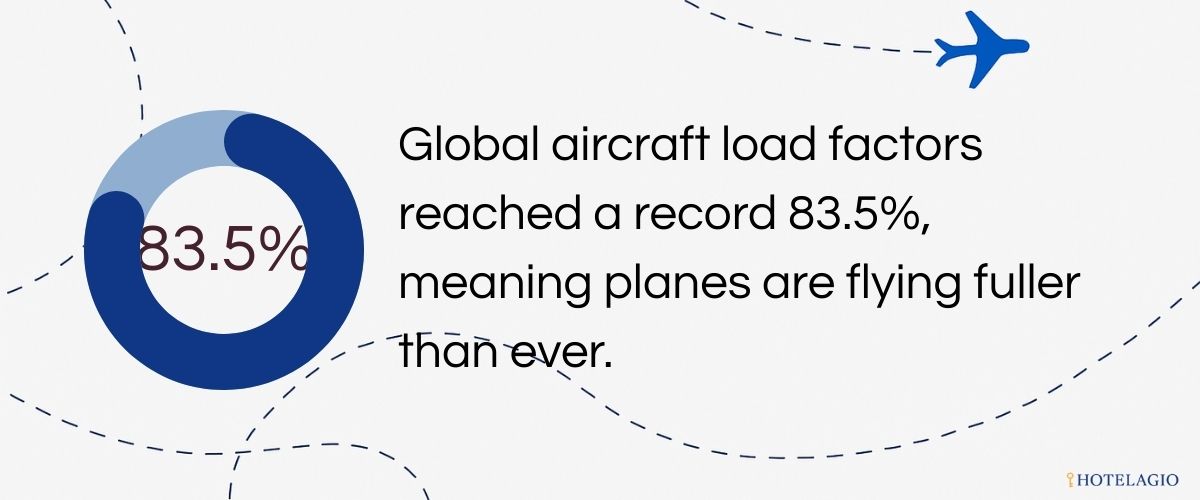
Passenger traffic grew by 10.4 percent compared with 2023 and ended the year 3.8 percent above 2019, while global load factors climbed to a record 83.5 percent, showing that aircraft are flying fuller than ever before.
Key Airline Industry Stats
- In 2024, airports worldwide handled around 9.5 billion passenger journeys, about 104 percent of 2019 levels, confirming that global air travel has fully recovered and moved beyond pre pandemic volumes.
- Airlines themselves are expected to carry about 5 billion individual travelers in 2024, up from roughly 4.4 billion in 2023, making it the busiest year for commercial aviation on record.
- Global passenger traffic in 2024 grew by 10.4 percent compared with 2023 and ended the year about 3.8 percent above 2019, with an average load factor of 83.5 percent, the highest ever recorded, meaning planes are flying fuller than ever.
- The airline industry is on track to generate around 996 billion USD in revenue in 2024 and 30.5 billion USD in net profit, a slim 3.1 percent profit margin that works out to roughly 6.14 USD profit per passenger after all costs.
- In 2024, airlines are expected to operate about 38.7 million flights worldwide, slightly below earlier plans because of aircraft delivery delays but still reflecting a very dense global network.
- By traffic share, carriers from Asia Pacific now account for about 33.5 percent of global passenger kilometers, Europe for 26.7 percent and North America for 22.9 percent, showing how strongly growth has shifted toward Asian markets.
- Air cargo is a small slice of world trade by volume, at roughly 1 percent, but it carries about one third of global trade by value and moved around 8 trillion USD worth of goods in 2023, from electronics to pharmaceuticals and fresh food.
- Aviation supports roughly 86.5 million jobs worldwide, including 11.6 million direct jobs, and contributes around 4.1 trillion USD to global GDP, which is close to 4 percent of the world economy when tourism effects are included.
- Commercial aviation emits close to one billion tonnes of CO2 a year, roughly 2.4 to 2.5 percent of global CO2 emissions, and industry estimates put 2024 airline emissions around 935 million tonnes, driven by consumption of about 99 billion gallons of jet fuel.
- Within that footprint, the richest half of the world is responsible for about 90 percent of aviation CO2 emissions, highlighting how air travel is still heavily concentrated among higher income travelers and regions.
- Sustainable aviation fuel (SAF) remains a niche player in 2024, covering only about 0.5 percent of global jet fuel demand, and airlines warn that limited supply and high prices are putting net zero 2050 ambitions under pressure.
How Many Passengers Travel by Air Each Year?
Air travel volumes have reached all-time highs as demand continues to expand across all regions.
According to the International Air Transport Association (IATA), global passenger numbers reached approximately 4.7 billion in 2024, surpassing the 2019 high of 4.5 billion.
Key figures:
- 2023 passenger traffic reached 94 percent of 2019 levels.
- 2024 traffic exceeded pre-pandemic volumes by roughly 4 percent.
- Passenger demand grew by more than 15 percent year-on-year in international markets.
- Domestic travel remains strong, especially in the United States, China, and India.
The global aviation industry is poised to exceed 5 billion passengers by 2026 if current trends continue.
How Much Revenue Does the Airline Industry Generate?
The airline industry has returned to profitability after several years of pandemic-driven losses.
IATA reports that global industry revenues reached approximately 964 billion USD in 2024, with net profits estimated at 25.7 billion USD.
Additional financial indicators include:
- Total airline operating expenses in 2024 exceeded 930 billion USD.
- Industry revenue per passenger averaged around 205 USD.
- Profit margins remain thin at approximately 2.6 percent.
- 2025 forecasts suggest revenues could surpass 1 trillion USD for the first time.
Despite recovery, profitability varies significantly among regions, with North American carriers consistently outperforming others.

Which Regions Have the Most Air Passengers?
Passenger distribution is uneven across global markets, with Asia-Pacific and North America leading growth.
| Region | Passenger Share (2024) | Notes |
|---|---|---|
| Asia-Pacific | ~35% | Fastest growth, rising middle class |
| Europe | ~27% | Strong international traffic |
| North America | ~24% | Highest revenue per passenger |
| Middle East | ~9% | Major long-haul hub expansion |
| Latin America | ~4% | Recovery slowed by economic factors |
| Africa | ~2% | Underserved but gradually expanding |
Asia-Pacific markets, especially India and Southeast Asia, are expected to drive more than half of new aviation demand over the next two decades.
Which Airlines Carry the Most Passengers?
The largest airlines by passenger volume maintain global dominance, though competition is intensifying in low-cost and long-haul markets.
| Airline | Passengers (2024 est.) | Notes |
|---|---|---|
| American Airlines | ~215M | Largest global carrier |
| Delta Air Lines | ~200M | High operational reliability |
| Southwest Airlines | ~160M | Largest low-cost carrier |
| United Airlines | ~150M | Major international network |
| Ryanair | ~183M | Largest European carrier |
| China Southern | ~120M | Strong domestic presence |
| China Eastern | ~115M | Rapid post-pandemic recovery |
| IndiGo | ~100M | India’s dominant low-cost airline |
Low-cost carriers represent the fastest-growing airline segment globally.
What Are the Most Common Types of Aircraft in Service?
Global fleets continue to modernize, with a focus on fuel-efficient narrowbody aircraft.
| Aircraft Model | Active Fleet (2024 est.) | Notes |
|---|---|---|
| Airbus A320 family | ~9,000 | Most popular narrowbody |
| Boeing 737 family | ~8,500 | Long-standing global workhorse |
| Boeing 777 series | ~1,700 | Leading long-haul aircraft |
| Airbus A350 family | ~600 | New-generation long-haul |
| Boeing 787 Dreamliner | ~1,200 | Fuel-efficient widebody |
| A330 family | ~1,450 | Strong in Asia and Europe |
New aircraft orders surged in 2023–2025, with Airbus and Boeing both reporting order backlogs exceeding 8,000 aircraft each.
Airline Operations Snapshot
Operational performance metrics have recovered strongly, though challenges persist.
Key indicators:
- Global average load factor: 82.5 percent (one of the highest in history).
- International load factor: 83.8 percent.
- On-time performance varies widely; North America and Asia lead, while Europe lags due to congestion.
- Jet fuel accounted for roughly 25 percent of airline operating costs in 2024.
- Pilot shortages remain significant, with estimates of 60,000 additional pilots needed globally by 2030.
Operational constraints pose significant risks despite robust demand.
Sustainability and Aviation: Emissions, Fuel, and Policy Trends
Aviation faces increasing pressure to decarbonize from governments, NGOs, and consumers.
Current sustainability trends include:
- Aviation accounts for approximately 2–3 percent of global CO₂ emissions.
- Sustainable Aviation Fuel (SAF) production increased 200 percent in 2024 but still represents less than 1 percent of total jet fuel use.
- Major airlines have committed to net-zero emissions by 2050.
- Several countries are implementing mandates requiring airlines to use minimum shares of SAF by 2030.
- Electric and hydrogen aircraft prototypes are under development, but commercial entry is expected post-2035.
Sustainability remains the industry’s most difficult long-term challenge.
Expert Insights
Willie Walsh — Director General, IATA
“The resilience in passenger demand highlights how essential aviation is to the global economy. But the industry’s profitability remains fragile, and cost control will be critical.”
Michael O’Leary — CEO, Ryanair
“European aviation continues to recover strongly, driven by low fares and capacity growth. Infrastructure constraints across Europe, however, remain a major problem.”
Paul Griffiths — CEO, Dubai Airports
“Aviation is entering a new phase of expansion, with global hubs seeing unprecedented passenger flows. Infrastructure must keep pace to support the next decade of growth.”
Annie Petsonk — Assistant Secretary for Aviation and International Affairs, U.S. Department of Transportation
“Sustainable aviation fuel is essential for meeting emissions goals, but scaling production will require unprecedented collaboration across industries.”
FAQ – Airline Industry Insights
How many people fly every year?
About 4.7 billion passengers flew in 2024, surpassing pre-pandemic levels.
Which airlines carry the most passengers?
American Airlines, Delta, Southwest, Ryanair, and United are among the largest global carriers by passenger volume.
What is the biggest challenge facing airlines today?
Sustainability, pilot shortages, infrastructure capacity, and rising operating costs are key challenges.
How much revenue does the airline industry generate?
The global airline industry generated around 964 billion USD in revenue in 2024.
Which region has the fastest-growing airline market?
Asia-Pacific is the fastest-growing market and will account for more than half of future aviation demand.
Sources
- International Air Transport Association (IATA) — Global Air Passenger Traffic and Revenue Reports (2023–2025)
- ICAO — International Civil Aviation Organization — Aviation Safety, Emissions, and Air Traffic Statistics
- Boeing Commercial Market Outlook — Aircraft demand forecasts and fleet updates
- Airbus Global Market Forecast — Global aircraft demand projections and sustainability trends
- OAG Aviation Analytics — Data on airline performance, schedules, and on-time rankings

0 Comment