

Air travel remains one of the safest forms of transportation ever developed, a fact consistently confirmed by global safety statistics.
According to international regulators, scheduled airlines are roughly 1,200 times safer than cars when comparing death rates per passenger mile, and the odds of dying in a plane crash are about 1 in 13 million.
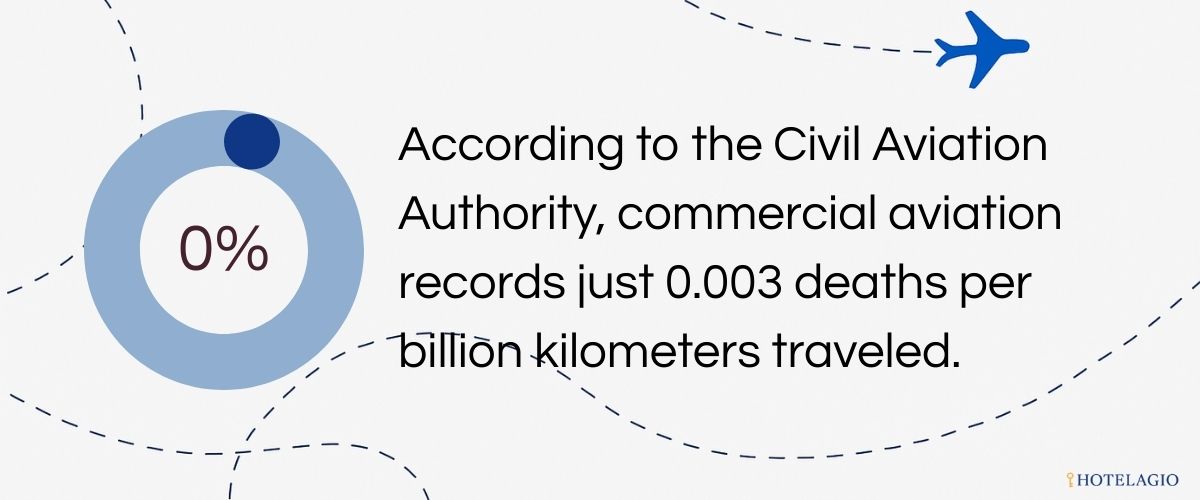
The Civil Aviation Authority reports a fatality rate of 0.003 per billion kilometres for commercial aviation, dramatically lower than for trains or cars.
Over a lifetime, the risk of dying as an airline passenger is estimated at 1 in 205,552, compared with 1 in 102 for cars, a difference so significant that air travel carries a 100,000-times lower fatality risk than driving, and is statistically safer than being struck by lightning.
These numbers illustrate why aviation continues to be the benchmark for transportation safety worldwide.
Key Air Travel Safety Stats
- Scheduled airlines are about 1,200 times safer than cars when comparing death rates per passenger mile.
- The Civil Aviation Authority reports a fatality rate of 0.003 per billion kilometres for planes, making them dramatically safer than trains or cars.
- Your odds of dying in a plane crash are about 1 in 13 million, far lower than the odds for a car crash.
- Lifetime risk of dying as an airline passenger is around 1 in 205,552, compared with 1 in 102 for cars.
- Air travel carries a 100,000 times lower lifetime fatality risk than driving and is even safer than your chance of being struck by lightning.
- In 2023, commercial jets recorded zero fatal accidents worldwide.
- European airlines flew over 7 million safe flights in 2023 with no fatalities.
- In 2024, there were 95 accidents worldwide, 10 fatal, still very low compared to total global departures.
- Passenger vehicles show death rates dozens of times higher than buses or trains and over a thousand times higher than scheduled airlines.
- Long term data shows steady declines in aviation accidents while global flight volumes continue to rise.
How Safe Is Air Travel Today?
Commercial aviation safety reached one of its strongest periods on record in 2024. According to international aviation safety monitoring bodies, the global accident rate continues to decline, reflecting advancements in aircraft design, navigation systems, pilot training, and regulatory oversight.
Key findings include:
- The accident rate for large commercial jets in 2024 was approximately 1 accident per 1.4 to 2.0 million flights.
- The fatal accident rate remained near historical lows, averaging about 0.03 to 0.06 fatal accidents per million flights.
- Over 99.999 percent of commercial flights land safely without incident.
- North America and Europe consistently record the lowest accident rates, while regional variations reflect differences in oversight and infrastructure.
Overall, air travel remains among the safest transportation systems ever created.

How Many Aviation Accidents Occur Each Year?
Aviation accident trends show a long-term decline, despite increased air traffic.
Data from recent years indicates:
- Between 20 and 30 aviation accidents involving commercial aircraft are recorded annually worldwide, most of which are non-fatal.
- Fatal accidents typically number between 2 and 6 per year.
- Annual fatalities fluctuate depending on the severity of individual events, but remain low relative to passenger volumes exceeding 4.5 billion travelers globally.
- 2024 saw fewer fatal accidents compared to the decade average, continuing a downward trajectory in fatality rates.
The sustained improvements result from systemic industry-wide collaboration on safety.
What Causes Most Aviation Incidents?
Accident investigations consistently highlight recurring categories rather than random failures.
| Cause Category | Estimated Contribution | Notes |
|---|---|---|
| Human factors (pilot error, miscommunication) | 50–60% | The most common contributing factor |
| Technical or mechanical failure | 15–20% | Often mitigated by redundancy systems |
| Weather conditions | 10–15% | Includes turbulence, storms, icing |
| Runway excursions or ground incidents | 10–15% | Frequently linked to operational factors |
| Air traffic control or procedural issues | 5–10% | Usually part of multi-factor causes |
Aviation remains highly resilient due to layered safety systems that prevent isolated failures from becoming catastrophic.
How Does Air Travel Compare to Other Forms of Transportation?
Flying continues to outperform all major transport modes in terms of safety.
- Air travel fatality rates are approximately 1 death per several million flights.
- In contrast, automobile travel has fatality rates measured in tens of deaths per billion kilometers traveled.
- Rail travel remains safer than automobile transport but significantly less safe than air travel.
- Maritime travel sees higher fatality and incident variability compared to aviation.
The data makes clear that aviation’s layered safety architecture far exceeds that of other transport systems.
Which Regions Have the Best Aviation Safety Records?
Regional safety performance varies based on regulation, investment, and infrastructure.
| Region | Safety Level | Notes |
|---|---|---|
| North America | Very high | Strong oversight and aging fleet renewal |
| Western Europe | Very high | Consistent regulatory enforcement |
| Oceania | High | Smaller market, excellent compliance |
| Asia-Pacific | Improving | Strong investment in safety and fleets |
| Middle East | High | Modern fleets and major carriers |
| Latin America | Moderate | Variability between countries |
| Africa | Mixed | Infrastructure and regulatory gaps persist |
Global bodies continue to invest in improving safety in emerging aviation regions.
What About Turbulence, Drones, and Other Emerging Risks?
New risk categories are receiving increased attention as the aviation landscape evolves.
Turbulence
- Turbulence-related injuries have risen due to climate change effects increasing clear-air turbulence in some regions.
- Most turbulence incidents remain minor, and no significant rise in fatal events has been recorded.
Drones and Unmanned Aerial Systems
- Drone incursions near airports continue to rise and pose operational risks.
- Regulatory bodies are expanding detection and enforcement systems to mitigate these threats.
Cybersecurity
- Cyber threats are an emerging concern as aircraft and airports rely increasingly on digital infrastructure.
- Industry response includes stronger encryption, redundancy, and cybersecurity protocols.
While risks evolve, aviation maintains strong frameworks for response and mitigation.
Aviation Technology and Safety Improvements
Technological innovation remains central to safety progress.
Notable advancements include:
- Enhanced ground proximity warning systems and terrain awareness tools.
- More precise GPS-based navigation (RNAV/RNP).
- Automation tools that reduce pilot workload during critical phases of flight.
- Improvements in aircraft materials, reducing fatigue and maintenance risks.
- Expanded use of simulators to train for rare but critical emergency scenarios.
- Increased emphasis on data-driven safety reporting systems.
These advancements contribute to the continued downward trend in accidents.
Expert Insights
Patrick Ky — Former Executive Director, European Union Aviation Safety Agency (EASA)
“Aviation safety continues to improve because the industry learns from every incident. No other sector shares safety data as openly and acts collectively with such consistency.”
Robert Sumwalt — Former Chairman, U.S. National Transportation Safety Board (NTSB)
“Modern aviation safety is built on layers of protection. When one system fails, others are in place to prevent an accident. This resilience is why air travel remains extraordinarily safe.”
Alexandre de Juniac — Former Director General, International Air Transport Association (IATA)
“Despite the growth of global air travel, the accident rate continues to decline. The industry’s long-term commitment to safety is unmatched in any other transport sector.”
FAQ – Air Travel Safety
How safe is flying compared to driving?
Air travel is significantly safer than driving, with fatality rates thousands of times lower.
How many aviation accidents occur each year?
Typically 20 to 30 accidents occur annually, with only a small fraction resulting in fatalities.
Is turbulence dangerous?
Turbulence rarely poses a serious safety risk, though it can cause injuries to unbelted passengers.
Which regions have the safest airlines?
North America, Western Europe, and Oceania consistently rank among the safest aviation regions.
Are modern aircraft safer than older planes?
Yes. Advancements in technology, materials, and automation contribute to safer aircraft and operations.
Sources
- International Air Transport Association (IATA) — Global accident rate reports and annual safety statistics
- Aviation Safety Network (ASN) — Accident database and global safety summaries
- European Union Aviation Safety Agency (EASA) — Safety review reports and regulatory updates
- Federal Aviation Administration (FAA) — Airworthiness directives, safety bulletins, and research
- National Transportation Safety Board (NTSB) — Investigation reports and safety recommendations

0 Comment