


Skyscanner is one of the most widely used travel search platforms.
The company says more than 100 million people use its app and website every month, with localized experiences across dozens of languages and markets.
Multiple independent industry bios now place that audience above 110 million monthly by late 2025. Skyscanner is part of Trip.com Group following a £1.4 billion acquisition announced in 2016.
Skyscanner’s own trend reports also give a window into traveler behavior.
In 2025, 54 percent of travelers said they were confident using AI to plan and book trips, up from 47 percent in 2024, based on a 22,000 person global survey cited across Skyscanner’s travel trends pages.
Key Skyscanner Stats
- Skyscanner serves over 110 million users each month worldwide.
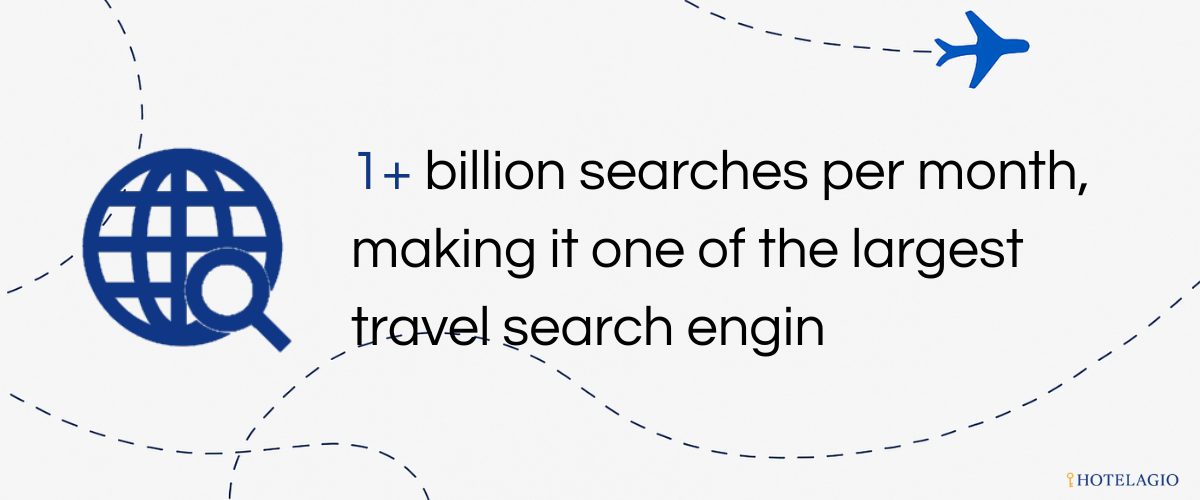
- The platform handles more than 1 billion searches per month, making it one of the largest travel-search engines globally.
- On a typical day, Skyscanner processes around 67 terabytes of data, reflecting the scale of its search operations.
- About 56% of users arrive on Skyscanner without a fixed destination in mind, implying more than half use it for discovery or inspiration rather than predefined travel plans.
- As of 2025, over 160 million unique users per month explore the platform’s offerings, indicating growth in user base and engagement.
- In 2025 Skyscanner recorded a ≈10% year-on-year increase in search volume, and an ≈11% rise in redirect/bookings, signaling rising demand and conversion.
- Among travellers surveyed globally for 2026: 84% say they plan to travel as much or more than the previous year.
- Of that surveyed group, 37% intend to spend more on flights, 31% plan to increase hotel budget, and 16% expect to spend more on car hire, showing rising travel budgets.
- Demand is shifting: for 2026, a growing number of users are booking multicity trips (33%), taking tours or activities (45%), or opting for seat-selection when flying (30%), suggesting changing travel priorities.
- In 2025–2026, Skyscanner data suggests rising interest in consciously-led travel behaviour, travellers increasingly consider sustainable, experience-driven holidays over last-minute deals.
How big is Skyscanner’s audience and where does it come from
Skyscanner’s public About page states more than 100 million people use the brand monthly.
Industry write ups in 2025 raise that to over 110 million monthly users, reflecting expansion in languages and markets. P
artner materials for conferences and media profiles consistently describe reach across roughly 180 countries and 30 to 40 plus languages.
Variations stem from time of publication and whether sources count all localized sites and app locales.
Audience footprint by source
| Source and date | Monthly users | Languages | Countries or markets |
|---|---|---|---|
| Skyscanner About page 2025 | 100 million plus | not specified here | global |
| Phocuswright sponsor bio 2025 | 110 million plus | 33 | 180 countries |
| Nimdzi profile Q3 2025 | 110 million plus | 40 plus | global |
| Skyscanner press and partner pages 2023 to 2024 | 100 million plus | 30 plus | 180 countries |
What do recent financials and ownership tell us
Skyscanner is a UK company within Trip.com Group.
Public reports around its 2023 UK accounts show revenue of £349.4 million and pre tax profit of £95.2 million, up strongly from 2022.
Trip.com Group’s filings provide broader group context rather than a Skyscanner only revenue split. The acquisition of Skyscanner for about £1.4 billion was announced in 2016.
Selected financial and corporate markers
| Item | Figure | Period or date |
|---|---|---|
| Revenue | £349.4 million | 2023 |
| Pre tax profit | £95.2 million | 2023 |
| Acquisition price | about £1.4 billion | 2016 |
| Parent | Trip.com Group | current |
What is Skyscanner seeing in traveler behavior
Skyscanner’s trend hub summarizes a large 22,000 person global survey and its own search data.
Reported highlights include a rise in comfort with AI for trip planning and booking to 54 percent in 2025 2026, and a third of travelers aiming to avoid crowded spots or shift to shoulder seasons due to overtourism concerns.
These are directional consumer signals rather than financial metrics, but they show how the platform reads demand.
Skyscanner trend indicators
| Indicator | 2024 2025 | 2025 2026 |
|---|---|---|
| Comfortable using AI to plan and book | 47 percent | 54 percent |
| Global survey base | 22,000 travelers | 22,000 travelers |
| Share actively seeking quieter destinations | n a | about one third |
How many partners and locales does Skyscanner support
Skyscanner commonly cites more than 1,200 flight, hotel, and car hire partners.
Language coverage has expanded from 30 plus to 33 and 40 plus depending on the 2023 to 2025 source.
These figures matter for advertisers and supply partners because coverage and localization can influence conversion and market entry.

Frequently asked questions about Skyscanner
How many people use Skyscanner each month
More than 100 million according to the company. Several industry profiles in 2025 cite over 110 million monthly users.
Who owns Skyscanner
Trip.com Group owns Skyscanner following a 2016 acquisition valued at about £1.4 billion.
How many languages does Skyscanner support
At least 30 languages in earlier materials, with 33 to 40 plus languages cited by 2025 sources.
What do we know about recent profitability
Public reporting on Skyscanner’s UK accounts shows 2023 revenue of £349.4 million and pre tax profit of £95.2 million.
What are the most recent consumer findings from Skyscanner’s research
In 2025 trend pages, 54 percent of travelers said they were confident using AI to plan and book, up from 47 percent the year before, based on a 22,000 person global survey.
Sources
- Skyscanner — About us
- Skyscanner — Year in Travel 2023
- Nimdzi — Lessons in Localization: Skyscanner
- Phocuswright Conference — Skyscanner exhibitor bio 2025
- City A.M. — Skyscanner profit jumps to almost £100m at travel search engine
- Wired — Skyscanner is being bought by China’s Ctrip for £1.4 billion
- Skyscanner Travel Trends — The Future of Travel and Tourism

0 Comment