


The global hospitality industry has entered a period of accelerated transformation shaped by shifting traveler expectations, economic uncertainty, digital innovation, and post-pandemic recovery.
In 2024, the worldwide hotel sector surpassed pre-2020 performance for the first time, generating an estimated 4.8 trillion USD in total tourism and hospitality activity.
Hotel occupancy, revenue per available room (RevPAR), and average daily rates (ADR) all climbed, driven by strong demand in North America, Europe, and the Middle East.
At the same time, workforce shortages, rising operational costs, and sustainability requirements place increasing pressure on hotels and hospitality brands.
Key Hospitality Industry Stats
- The global hospitality market reached around USD 4.9 trillion in 2024, powered by a rebound in leisure trips and the rise of bleisure travel where people mix business trips with vacations.
- By 2029, the hospitality market is expected to grow to about USD 6.9 trillion, which means a solid compound annual growth rate of roughly 6 percent over the next few years.
- The broader Travel and Tourism sector, which includes hotels, resorts and other hospitality businesses, is on track to generate a record USD 11.7 trillion in 2025, about 10.3 percent of global GDP.
- In 2024, Travel and Tourism already contributed around USD 10.9 trillion to the world economy, representing 10 percent of global GDP, so the sector is essentially back to being a tenth of the global economy.
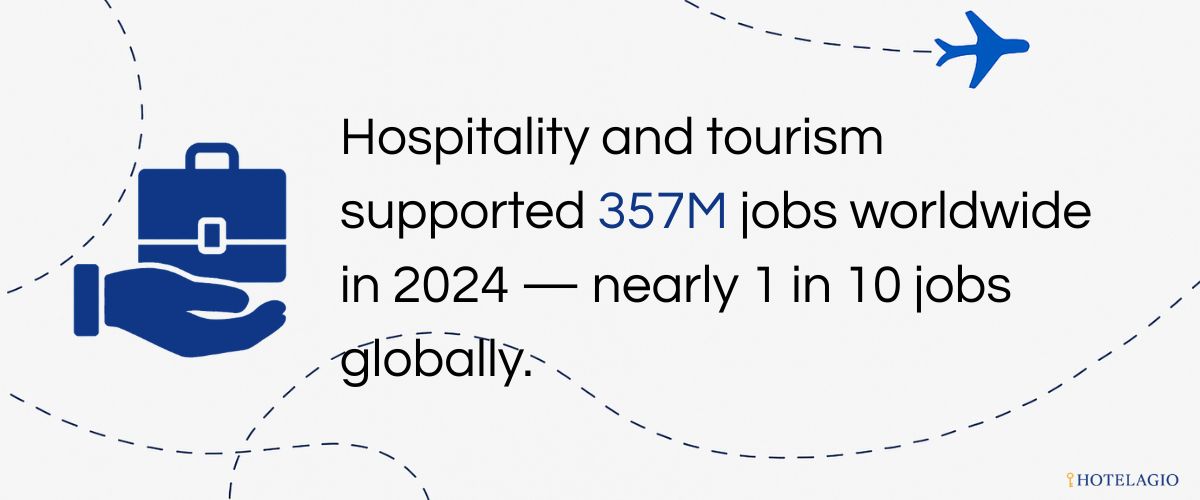
- The industry is a major employer. Hospitality and tourism supported about 357 million jobs worldwide in 2024, and this figure is expected to rise to around 371 million jobs in 2025, which is close to one in ten jobs on the planet.
- Hotel occupancy has largely recovered. Globally, occupancy hovered around 69 percent in 2023, with Europe ending 2023 at about 69 percent occupancy across key markets, a clear sign that rooms are filling again.
- Profitability is improving too. Forecasts for the hotel sector suggest average daily rates are set to grow by around 4.9 percent, while revenue per available room is expected to reach about 93 US dollars in the near term, reflecting strong pricing power in many markets.
- The hospitality industry is now heavily digital. Roughly 65 percent of all travel bookings in 2023 were made online, and about 35 percent of those online sales came from mobile devices, showing how central phones have become to trip planning.
- The online travel market itself is already huge. It was valued at about USD 512.5 billion in 2023 and is projected to reach roughly USD 1.26 trillion by 2030, as more travelers shift to booking platforms and apps.
- Travelers clearly prefer digital channels. In surveys, around 72 percent of travelers said they preferred to book online in 2023, making web and mobile experiences a central battleground for hospitality brands.
- Sustainable travel has become a mainstream expectation. In Booking com research for 2025, 84 percent of global travelers say traveling more sustainably is important, and an impressive 93 percent say they want to make more sustainable choices when they travel.
- Earlier research from 2024 showed that roughly three quarters of travelers wanted to travel more sustainably over the next 12 months, underlining how environmental and social impact are now part of the core value proposition in hospitality.
How Large Is the Global Hospitality Industry Today?
The hospitality sector is one of the world’s largest service industries, encompassing lodging, food and beverage, events, travel, and tourism services.
Key figures:
- Global hospitality and tourism contributed approximately 4.8 trillion USD to the global economy in 2024.
- The global hotel industry alone generated over 950 billion USD in revenue.
- The sector supports around 334 million jobs worldwide, representing nearly 10 percent of global employment.
- Hospitality demand grew by 12–15 percent between 2022 and 2024 as international travel recovered.
These numbers confirm the resilience of hospitality as a core economic pillar worldwide.
How Many Travelers Use Hotels and Alternative Accommodations?
Hospitality demand continues to diversify between hotels, resorts, vacation rentals, and hybrid models.
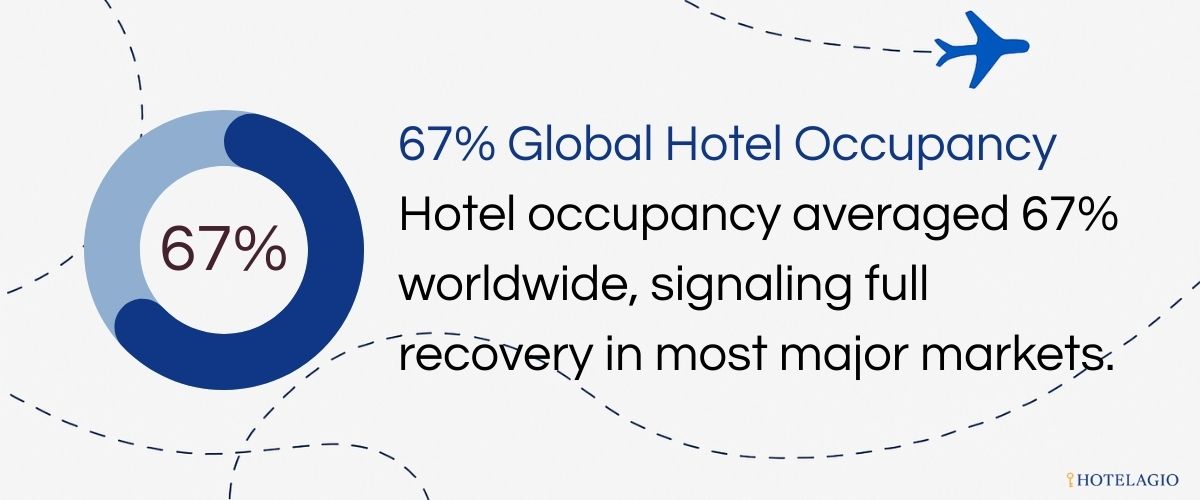
- In 2024, global hotel occupancy averaged 67 percent, up from 62 percent in 2023.
- Urban markets such as Dubai, Singapore, London, and New York exceeded 75–80 percent occupancy.
- Vacation rentals grew to represent 18 percent of global lodging revenue.
- Nearly one in three travelers stayed in an alternative accommodation at least once in 2024.
Hybrid hospitality – combining hotel services with home-style stays – is expected to expand significantly through 2030.
Global Hospitality Revenue Trends
Hospitality performance indicators strengthen across most regions.
- Worldwide ADR increased by 6–9 percent year-over-year in 2024.
- RevPAR grew by 10–14 percent, driven by higher occupancy and rate increases.
- Luxury and upper-upscale hotel segments showed the fastest growth, with ADR increases of 8–12 percent.
- Food and beverage spending now accounts for 30–35 percent of hotel revenue in many markets.
While recovery is strong, rising operating expenses continue to pressure margins.
Which Countries Generate the Most Hospitality Revenue?
Demand remains concentrated in major tourism economies.
| Country / Region | 2024 Hospitality Revenue (est.) | Notes |
|---|---|---|
| United States | 380B USD | Largest hotel market globally |
| China | 160B USD | Rapid domestic travel recovery |
| Europe (combined) | 250B USD | Strong luxury and leisure demand |
| Middle East | 60B USD | High-value international arrivals |
| Southeast Asia | 45B USD | Rising travel demand post-pandemic |
| Latin America | 30B USD | Steady growth in resort markets |
The U.S., Europe, and China remain the industry’s core revenue engines.
What Are the Most Significant Trends Shaping Hospitality in 2025?
A number of structural shifts define the modern hospitality landscape.
Key trends include:
- Digital check-in and contactless services used by over 60 percent of hotel guests.
- AI-driven personalization, such as customized pricing, upsells, and guest experience systems.
- Sustainability certifications, with nearly 30 percent of hotels implementing formal environmental programs.
- Bleisure travel, which blends business and leisure, representing 40 percent of corporate travel.
- Extended-stay and serviced-apartment growth, fueled by remote workers and long-term guests.
- Dynamic pricing models increasingly powered by predictive analytics.
Technology and lifestyle shifts are driving the evolution of hospitality operations.
What Are the Biggest Challenges Facing the Hospitality Industry?
Despite strong recovery, several structural challenges persist.
Current barriers include:
- Labor shortages across all regions, with staffing gaps of 10–20 percent.
- Rising energy and utility costs, heavily affecting full-service hotels.
- Inflation-driven price sensitivity among leisure travelers.
- Competition from short-term rentals, reducing market share in some cities.
- Sustainability compliance pressures, with stricter government regulations worldwide.
- Cybersecurity risks linked to digital transformation.
The industry must balance growth with operational resilience and workforce rebuilding.
Hotels Snapshot
Recent performance indicators for the global hotel sector:
- Global hotel occupancy: 67 percent
- ADR: 145–155 USD average worldwide
- RevPAR: 95–105 USD depending on region
- Luxury occupancy: 72–78 percent
- Budget and midscale: 65–71 percent
- Over 30 percent of hotels adopted energy-efficiency or environmental practices
- Digital check-in usage: 60–68 percent globally
The hotel sector is now largely stabilized, with steady gains projected through 2030.
Expert Insights
Sebastien Bazin — CEO, Accor
“Hospitality is no longer just about rooms. It is about experiences, community, and flexibility. Our industry must adapt faster than ever before to meet the expectations of the next generation of travelers.”
Christopher Nassetta — CEO, Hilton
“Demand remains incredibly strong across all regions, but labor, supply chain, and cost pressures require new levels of operational efficiency and innovation.”
Julia Simpson — President & CEO, World Travel & Tourism Council
“The hospitality sector is a critical engine of global economic growth, but resilience and sustainability will determine its long-term success.”
Guy Langford — Deloitte Global Travel & Hospitality Leader
“Technology is rewriting the rules of competition. Companies that deploy AI and data-driven systems effectively will lead the next phase of hospitality.”
FAQ – Hospitality Industry Insights
How large is the global hospitality industry today?
The industry generates approximately 4.8 trillion USD in economic impact, supporting more than 330 million jobs worldwide.
Which regions have the strongest hospitality performance?
North America, Western Europe, and the Middle East recorded the strongest results in occupancy, ADR, and RevPAR.
Are alternative accommodations disrupting hotels?
Yes. Vacation rentals account for around 18 percent of global lodging revenue and continue to erode traditional hotel market share in key cities.
What challenges are most significant for 2025?
Labor shortages, rising operating costs, and sustainability requirements are among the top challenges affecting hotel profitability.
What technologies are most influential?
AI personalization, digital check-in, predictive pricing tools, and automation systems are shaping the next era of hospitality.
Sources
- World Travel & Tourism Council (WTTC) — Global hospitality and tourism economic impact reports
- STR / CoStar — Global hotel performance data: occupancy, ADR, RevPAR (2023–2025)
- Deloitte Travel & Hospitality Outlook — Industry trends, technology adoption, and workforce insights
- McKinsey & Company — Research on hospitality transformation, AI, and consumer behavior
- Booking Holdings & Airbnb Reports — Alternative accommodation and traveler behavior data

0 Comment