


The global cruise industry has undergone one of the most rapid and resilient recoveries in the entire tourism sector.
After a complete shutdown in 2020, cruising has not only rebounded but surpassed its pre-pandemic levels.
In 2023, the industry carried 31.7 million passengers, exceeding the 2019 record of 29.7 million. Forecasts for 2024–2025 indicate continued expansion, with passenger volumes expected to reach between 34 and 36 million annually.
The growth is fueled by strong demand in North America and Europe, expanding capacity, the launch of new mega-ships, and rising interest in expedition and luxury cruising.
Key Global Cruise Industry Stats
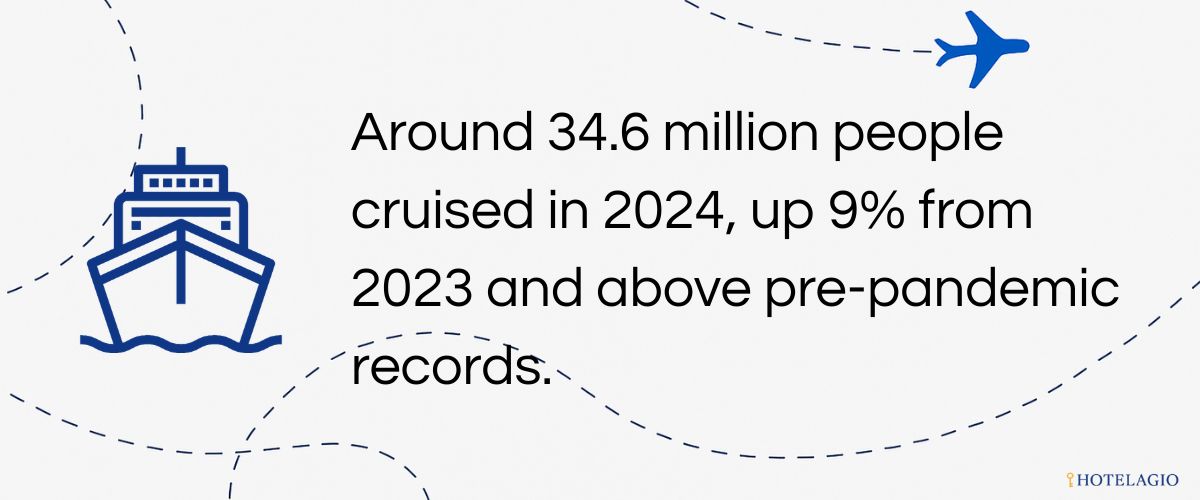
- In 2024, around 34.6 million people took an ocean cruise worldwide, up roughly 9 percent from 31.7 million cruisers in 2023, clearly above pre pandemic volumes.
- Cruises still form a focused niche within tourism. Even at record levels, ocean cruising accounts for less than 3 percent of all global international trips, which shows how much space there is to grow.
- The industry is not slowing down. Forecasts suggest about 37.7 million ocean going cruise passengers in 2025, setting another all time high for the sector.
- Fleet size is climbing too. CLIA member lines operate around 310 ocean going ships, while total worldwide ocean cruise capacity is expected to reach roughly 704,000 berths across about 370 ships by the end of 2025.
- At the very top of the market, big is truly big. More than 120 mega cruise ships now sail globally, each designed to carry over 3,000 passengers and packed with headline grabbing amenities.
- North America remains the powerhouse source market. Travelers from this region generated about 20.5 million cruise passengers in 2024, representing a large share of global demand.
- Asia and Oceania are building momentum. Together they welcomed around 4.0 million cruise guests in 2024, with high single digit growth year on year as more ships are deployed into the region.
- Occupancy has rebounded strongly from the pandemic era. After sitting near 50 percent in 2021, global cruise occupancy climbed to roughly 78 percent in 2022, with many markets now regularly sailing in the 90 percent plus range.
- The typical cruise customer is not as old as the stereotype suggests. The average age of a cruise guest sits in the mid forties, and more than one third of cruise travelers are under 40, signaling a younger and more diverse audience.
- Financially, cruises remain powerful yield machines. Estimates suggest an average net profit of about 291 US dollars per passenger for cruise lines, which helps explain the constant stream of new ship orders.
- Higher end products are expanding fast. The luxury cruise segment has roughly tripled in size since 2010 when measured by number of ships, while expedition and exploration cruises saw passenger numbers jump about 22 percent between 2023 and 2024 alone.
How Many People Cruise Each Year?
Global cruise passenger numbers have climbed steadily since 2021, surpassing all initial recovery projections.
- 2019: 29.7 million passengers
- 2020: 5.8 million (pandemic shutdown)
- 2022: 20.4 million
- 2023: 31.7 million
- 2024 estimate: ~34 million
- 2025 forecast: 36 million or more
Travel intent remains high, with surveys showing that more than 80 percent of past cruisers plan to sail again within the next two years.
How Much Revenue Does the Cruise Industry Generate?
Cruising contributes substantially to the global tourism economy.
Industry-wide revenue reached an estimated 54 billion USD in 2023, driven by passenger spending both on board and in ports.
Key revenue indicators:
- Average passenger on-board spending: 200–300 USD per day
- Average shore excursion spend: 70–100 USD per port day
- Global economic impact (direct + indirect): ~138 billion USD annually
- Significant job creator: approximately 1.2 million jobs supported globally
Luxury and expedition cruising, though smaller in volume, continue to record the highest per-passenger spending.
Which Countries Produce the Most Cruise Travelers?
Cruise participation varies significantly by region, with North America dominating the market.
| Market | Share of Global Cruise Passengers | Notes |
|---|---|---|
| United States | ~52% | The largest and most mature cruise market |
| Europe (total) | ~23% | Driven by UK, Germany, Italy, Spain, France |
| United Kingdom & Ireland | ~3.1M passengers | Strong ocean and river cruise culture |
| Germany | ~2.5M | High interest in river cruising |
| Australia/New Zealand | ~1.25M | High per-capita cruise rates |
| Asia | ~2.1M | Recovering growth, especially in Japan & Singapore |
Together, the US, UK, and Germany account for the majority of global cruise demand.
Which Are the Busiest Cruise Ports in the World?
Cruise port activity has also surpassed pre-pandemic levels. The Caribbean remains the world’s leading cruise region.
| Port | Passenger Movements (2023–24 est.) | Notes |
|---|---|---|
| Miami, USA | ~7.3M | World’s busiest cruise port |
| Port Canaveral, USA | ~6.9M | Rapid growth, new terminals |
| Port Everglades, USA | ~4.3M | Major embarkation hub |
| Cozumel, Mexico | ~3.6M | Leading Caribbean destination port |
| Nassau, Bahamas | ~4.0M | Recently expanded cruise facilities |
| Barcelona, Spain | ~3.5M | Europe’s busiest cruise port |
| Civitavecchia (Rome), Italy | ~2.8M | Gateway to Rome |
| Marseille, France | ~2.2M | Mediterranean hub |
| Dubai, UAE | ~1.3M | Growing regional cruise center |
| Singapore | ~1.4M | Major port in Asia-Pacific |
The Caribbean accounts for roughly 44 percent of global cruise deployments.
What Types of Cruises Are Growing Fastest?
The industry is diversifying beyond large ocean liners, with notable expansion in the following segments:
- Expedition cruising to Antarctica, the Arctic, and the Galápagos
- Luxury small-ship cruising with higher crew-to-guest ratios
- River cruising in Europe, North America, and Asia
- Themed cruises (culinary, music, wellness)
- Eco-friendly itineraries designed to reduce environmental footprint
Expedition cruising is the fastest-growing segment, with annual demand increasing 10–12 percent.
Sustainability Challenges in the Cruise Industry
Despite strong demand, sustainability remains one of the cruise sector’s most pressing challenges.
Key issues include:
- Cruise ships’ reliance on fossil fuels, especially heavy fuel oil
- Port congestion and environmental impact on popular destinations
- Air quality issues in port cities
- Waste management and water treatment concerns
- Carbon reduction targets that vary widely between operators
The industry is investing in solutions such as LNG-powered ships, shore power systems, advanced wastewater treatment, and trials of methanol, hydrogen, and battery hybrid technologies.
Cruise Fleet and Capacity Expansion (2024–2027)
Cruise lines continue launching new ships with larger capacities and improved sustainability features.
Between 2024 and 2027:
- More than 50 new cruise ships are scheduled for delivery
- Approximately 10 of these are LNG-powered
- Expedition ships remain the fastest-growing fleet category
- Several lines target net-zero emissions by 2050
As of 2025, the global cruise fleet includes more than 300 active ships.

Expert Insights
Kelly Craighead — President & CEO, Cruise Lines International Association (CLIA)
“Cruising continues to lead the travel sector in passenger satisfaction and resilience. Our 2023 and 2024 numbers demonstrate that global demand for cruising is stronger than ever.”
Michael Bayley — President & CEO, Royal Caribbean International
“Innovation is driving the future of cruising. From new ships and onboard experiences to advancements in sustainability, we’re seeing record demand across every market we serve.”
Pierfrancesco Vago — Executive Chairman, MSC Cruises
“The cruise industry is committed to achieving net-zero emissions by 2050. This requires unprecedented collaboration, technological investment, and a long-term approach to sustainability.”
FAQ – Cruise Industry Insights
How many people cruise each year?
Around 31.7 million people cruised in 2023, with forecasts reaching 36 million by 2025.
Which country has the most cruise passengers?
The United States accounts for over half of global cruise travelers.
What is the busiest cruise port in the world?
PortMiami remains the busiest, handling more than 7 million passengers per year.
How much money does the cruise industry generate?
The global economic impact exceeds 138 billion USD annually.
Are cruises becoming more environmentally friendly?
Cruise lines are investing in LNG ships, shore power, and advanced water treatment systems, although full sustainability remains a long-term challenge.
Sources
- Cruise Lines International Association (CLIA) — Global Cruise Industry Reports and 2024–2025 Passenger Statistics
- PortMiami — Annual Traffic Reports and Passenger Volume Data
- Cruise Industry News — Market Insights, Fleet Data, and New Ship Deliveries
- Statista — Global Cruise Revenue and Passenger Market Statistics
- UN Tourism — Tourism Economic Impact and Market Recovery Reports

0 Comment